

What is 3PL?
What is 3PL?
What is 3PL?
What is 3PL, what services do 3PL companies offer, and how does a 3PL warehouse work? The differences between 1PL, 2PL, and 4PL, along with warehouse shelving layout, all in one article.
3PL is the outsourcing of a business's warehousing and logistics operations to a third-party company. The acronym stands for "third party logistics".
In this model, ownership of the product remains with the business, while the transportation and warehousing processes transfer to the service provider. The business utilizes an existing infrastructure instead of establishing its own warehouse.
There is no single definition of 3PL. The scope of the service provided can range from basic warehousing only to complete order fulfillment.
What Does 3PL Mean?
The term is part of a classification describing how many parties are involved in the logistics process. The third party refers to the service provider outside of the buyer and the seller.
In practice, the 3PL company receives the product, stores it in its warehouse, and delivers it to the end recipient according to the order. The operation is carried out in its own facility, with its own equipment, and with its own personnel.
For the business, this means paying a service fee instead of making a fixed investment.
What Services Do 3PL Companies Offer?
The scope of services is determined by contract, but the core headings are similar.
Warehousing: Storing the product under appropriate conditions and based on designated locations.
Receiving and put-away: Counting, inspecting incoming cargo, and placing it into rack addresses.
Order picking and packing: Picking products subject to orders and preparing them for shipment.
Shipping and distribution: Coordination with cargo and transport companies, outbound scheduling.
Returns management: Inspecting, sorting, and restock of returned products.
Value-added services: Labeling, kitting, bundling, and similar preparatory tasks.
As the scope of service expands, the racking layout in the warehouse also changes; the picking level, reserve area, and packing zone are planned accordingly.
What Are the Differences Between 1PL, 2PL, 3PL, and 4PL?
The classification is made according to who runs the operation.
Model | Operator of the process | Typical scope |
|---|---|---|
1PL | The business itself | Own warehouse, own fleet |
2PL | A single service provider | Transportation only or warehousing only |
3PL | Integrated service provider | Warehousing, picking, and shipping combined |
4PL | Coordinating party | Management of multiple providers, does not own the operations |
The main distinction between 4PL and 3PL is that a 4PL typically does not operate its own warehouse and fleet. A 4PL designs and manages the process.
How Does a 3PL Warehouse Work?
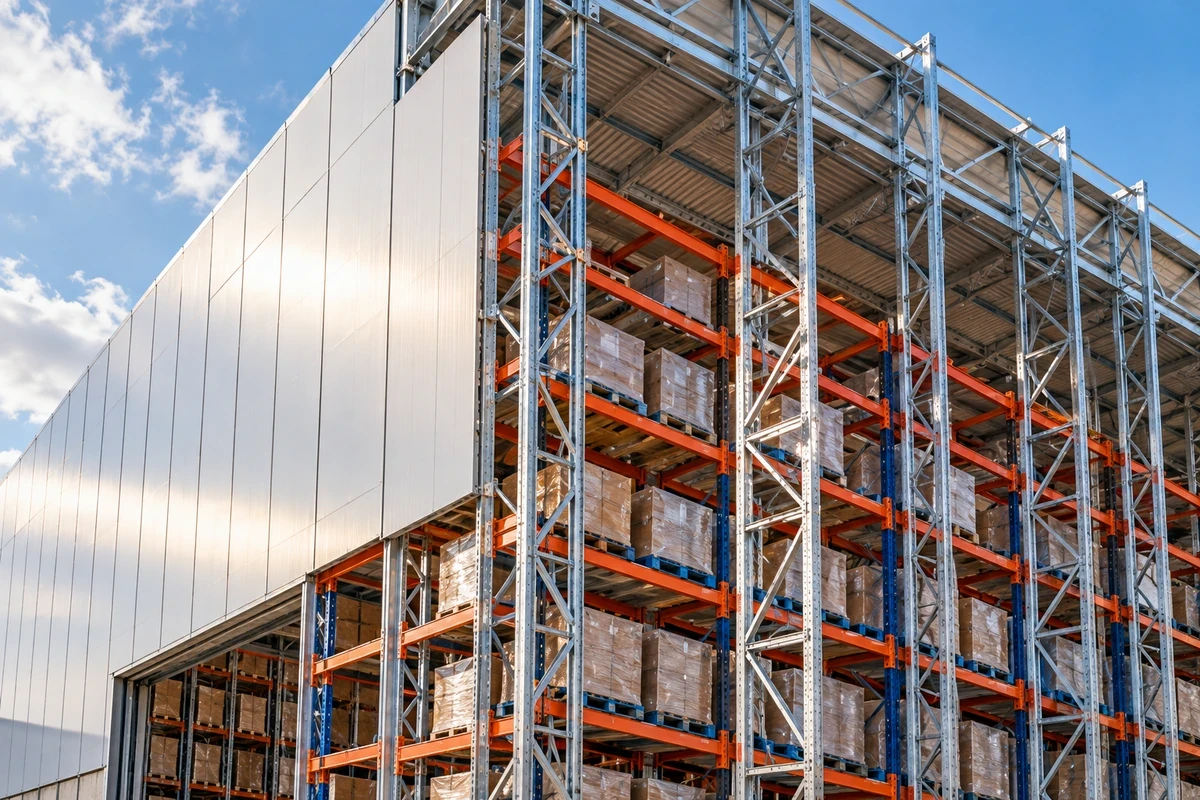
In a 3PL warehouse, inventory from multiple customers is kept in the same facility. Therefore, location management and inventory segregation are more critical than in proprietary warehouses.
Incoming cargo goes through goods receipt, is counted, and entered into the system. Put-away is carried out according to rules determined by the turnover rate of the product and its customer.
When an order arrives, a pick list is generated, and the products are picked from their addresses. After packing and labeling, they are sorted in the shipping area according to the outbound vehicle.
All movements are recorded in the warehouse management system; the customer monitors inventory and order status through these records.
Why Is 3PL Preferred in E-Commerce?
In e-commerce, order volumes fluctuate rapidly depending on seasons and campaign periods. A business operating its own warehouse is forced to plan space and staffing based on peak periods.
In the 3PL model, capacity belongs to the service provider; space and workforce scale during peak periods, and costs decrease during quiet periods.
In this structure, where the number of SKUs is high and the quantity of items per order is low, picking speed directly affects cost. Therefore, in 3PL warehouses, the configuration of the picking level is just as important as the racking itself.
What Should Be Considered When Choosing a 3PL Company?
Capacity and flexibility: The ability to provide additional space and personnel during peak periods.
System infrastructure: The warehouse management system's capability to exchange data with your own system.
Inventory accuracy: The counting method and historical accuracy rates.
Product compatibility: The temperature, hygiene, and security conditions required by your product category.
Contract scope: Which operations are included in the service and which are billed additionally.
Location: The distance of the warehouse to key consumer regions and transportation routes.
Which Racking Systems Are Used in 3PL Warehouses?
In a multi-client setup, it is difficult to rely on a single rack type. Access to every pallet is necessary in areas with high SKU variety, while high-density storage comes to the fore in areas where many pallets of few SKUs are held. All options can be reviewed under the racking systems heading.
In e-commerce operations where carton-based picking is intense, the carton flow rack system, where products advance to the picking face by gravity, shortens picking times.
When order volume and SKU counts exceed a certain threshold, the operation becomes automated. At this point, automated storage systems combine racking, machinery, and software into a single setup.
3PL is a scalable model for businesses that want to procure warehousing and logistics as a service. However, when the racking configuration is not planned according to product profiles and order structures, picking times and costs rise rapidly even within the same facility.
Frequently Asked Questions (FAQ) About 3PL
Frequently Asked Questions (FAQ) About 3PL
Frequently Asked Questions (FAQ) About 3PL
Is 3PL and a courier company the same thing?
They are not the same. A courier company provides transportation services, whereas a 3PL company handles warehousing, picking, packing, and shipping together. A 3PL company works with courier companies during the shipping phase.
Which services does a 3PL contract cover?
How is inventory tracking done in 3PL warehouses?
Can small businesses use 3PL services?
What is the difference between a 3PL warehouse and a bonded warehouse?


Contact
Do you want to receive more information? We have expert and reliable contact persons available for any questions, issues, and suggestions.
Reta Engineering Warehouse Racking Systems Industry and Trade Inc.
Address
Muradiye Organized Industrial Zone, 10th St. No: 30 Yunusemre / Manisa
info@retamuhendislik.com.tr