
When Does an Investment in Storage Systems Pay for Itself?
When Does an Investment in Storage Systems Pay for Itself?
When Does an Investment in Storage Systems Pay for Itself?
Learn the factors that affect the payback period of a storage system investment, depreciation calculations, and how to choose the right system.
Learn the factors that affect the payback period of a storage system investment, depreciation calculations, and how to choose the right system.
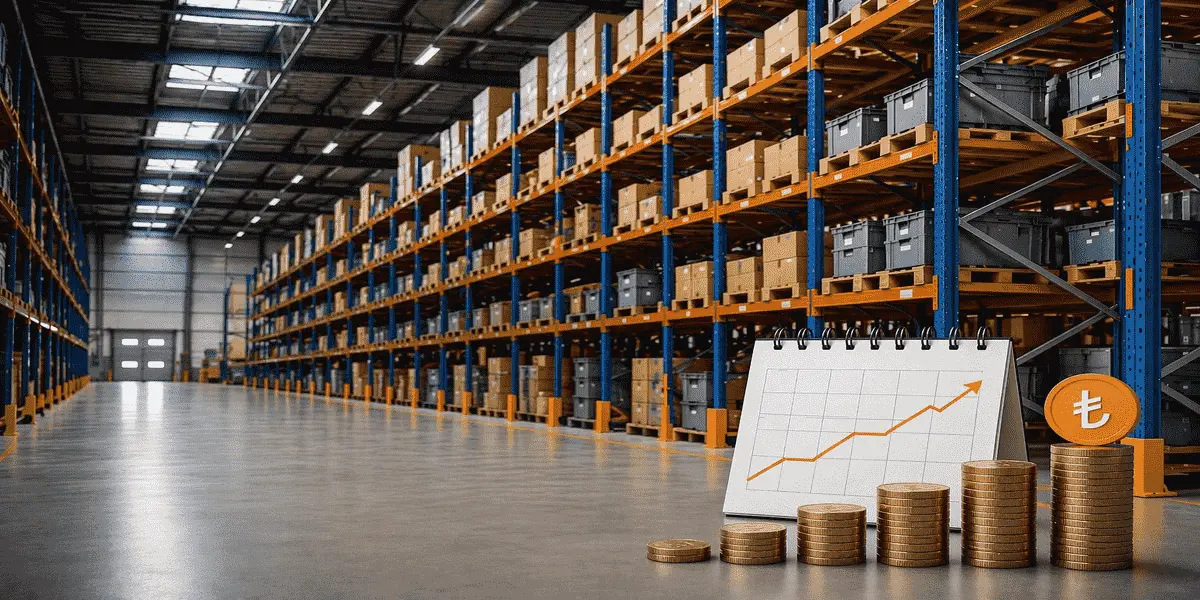
Investment in storage systems is not merely an expense made to create additional rack capacity. When planned correctly, this investment becomes a strategic step that optimizes space utilization, increases labor efficiency, streamlines operational flow, and can postpone the need for a new facility during growth periods. Therefore, the question “When does an investment in storage systems pay for itself?” requires not only a financial assessment but also an operational one.
From a general perspective, investment in storage systems pays for itself in most businesses within 2 to 5 years. However, this period is not fixed. Warehouse density, product turnover rate, labor cost, shipment volume, current space utilization, and the selected system type directly affect the payback period. In some projects, the return is achieved in the 18 to 24 month range, while in investments where capacity planning is done incorrectly, this period can be noticeably longer.
At this point, the first principle for a healthy evaluation is clear: a storage investment should be calculated not based on the initial purchase price, but by considering total benefit, total cost, and operational impact together.
How Is the Return on Investment of Storage Systems Calculated?
The basic formula for understanding when a storage investment will pay for itself is as follows:
Payback Period = Total Investment Cost / Annual Net Gain
The total investment cost here does not consist only of the rack price. All of the following items should be included in the calculation:
Project design expenses
Manufacturing and procurement cost
Installation and commissioning expenses
Required equipment adaptations
Efficiency loss during the operational transition period
Maintenance, safety, and long-term usage expenses
In the annual net gain section, not only labor reduction but the entire operational performance should be evaluated. In a healthy calculation, the following items stand out:
Higher storage capacity per square meter
Labor savings or higher transaction volume with the existing staff
Reductions in product damage, picking errors, and inventory discrepancy costs
Postponing the need to rent a new warehouse or expand the facility
Efficiency gains resulting from increased shipment speed
Calculations made without this perspective remain incomplete. Especially in medium and large businesses, the return on investment accelerates more through improved operational quality than through physical capacity increase.
Which Factors Determine the Payback Period?
An investment in storage systems produces different results in every business. Two warehouse systems installed with the same budget can generate completely different payback periods in two different facilities. The reason is that the financial outcome of the investment depends on field realities.
Space Utilization Rate
If the existing warehouse is high-ceilinged but used at low density, the return on investment will be faster. Because the new structure allows more stock to be stored in the same area. This directly creates a cost advantage by delaying the need for a new warehouse.
For example, when mezzanine systems or mezzanine rack systems are chosen in a warehouse that requires a multi-level layout, not only horizontal but also vertical space is used effectively. This approach increases investment efficiency especially in retail logistics, spare parts storage, and manual picking areas.
Product Turnover Rate
In products with fast inbound and outbound movement, system selection directly affects the payback period. In high-circulation products, ease of access, picking time, and forklift travel distance become critical. Therefore, storage design must be aligned with product movement.
In operations with high volume but a limited SKU structure, a drive-in racking system may provide denser storage. In contrast, structures with a high number of SKUs and a strong need for order separation require a different system approach. The goal here is not maximum capacity, but the right operational balance.
Workforce Structure
A storage investment is often made not to reduce headcount, but to achieve higher output with the same team. Especially in warehouses with intensive manual processes, when rack layout, aisle planning, and product access arrangement are improved, daily processing capacity increases significantly.
In businesses that need more locations within a narrow space, choosing a narrow aisle racking system can provide space savings as well as make warehouse flow more controlled. However, for this system to truly deliver efficiency, equipment compatibility, turning radius, and operational scenarios must be assessed by experts.
Error, Damage, and Inventory Accuracy
A storage investment is not only about increasing capacity. Incorrect product placement, damaged stacking, mixed addressing, and irregular access are issues that are often unnoticed but create high costs. Therefore, error rates must definitely be considered in the return calculation.
In many businesses, product damage, rehandling, incorrect shipments, and return processes make up the invisible part of the total cost. When proper design, suitable rack geometry, and an orderly operation reduce these losses, the payback period becomes shorter than expected.
Why Is It Wrong to Decide Based Only on Rack Price?
The most common mistake when evaluating a storage investment is focusing only on the initial purchase cost. However, a low initial cost often does not mean a low total cost. If the system does not fit the business structure, an investment is made; yet no return is achieved.
For example, a low-budget system that is not suitable for the operational flow may lead to the following results:
Order picking time does not shorten as expected
Product access becomes more difficult
Forklift and staff movement slows down
The damage rate continues
Even if capacity increases, processing efficiency does not improve
Therefore, the correct approach is not “Which system is the most economical?” but rather “Which system produces the most appropriate total benefit?” This approach should be decisive in the investment discipline of corporates operating at scale.
Which Systems Deliver a Faster Return on Investment in Storage Systems?
There is no single ideal structure for every warehouse. The system that delivers the fastest return is the one that best fits the company’s product flow and growth plan.
For example;
In warehouses that require high SKU variety and selective access, a double-deep racking system can offer a controlled and flexible solution.
In structures where space is highly valuable and aisle area needs to be minimized, a mobile racking system can provide a significant capacity advantage.
In operations that need more advanced automation, want to reduce error rates and increase processing speed, automated storage AS/RS racks may require a higher initial investment, but they can create strong long-term efficiency potential.
The important point here is that system selection should not be made solely from a catalog. Product dimensions, pallet type, order frequency, inbound-outbound balance, forklift parking, and future capacity scenarios should all be evaluated together. At this point, an experienced solution partner becomes one of the most critical stakeholders in determining the return on investment.
An Example Payback Calculation
Let’s assume that a storage system investment worth 3,200,000 TL is planned for a medium-sized logistics company. Let this investment include the rack system, project design, manufacturing, installation, and on-site commissioning expenses.
The annual gain items after the investment may be as follows:
Gain Item | Annual Financial Impact |
Deferring the Need for Additional Warehouse Space Thanks to Space Efficiency | 900.000 TL |
Increase in Labor Efficiency | 550.000 TL |
Reduction in Damage and Mis-picking Costs | 220.000 TL |
Operational Contribution of Increased Shipment Speed | 180.000 TL |
Total Annual Net Gain | 1.850.000 TL |
In this table, the payback period is approximately:
3.200.000 / 1.850.000 = 1.73 years
In other words, the investment can theoretically pay for itself in about 21 months.
However, there is an important point to consider in practice: the full efficiency may not always be achieved in the first year. Due to the transition to the new warehouse layout, staff habits, layout optimization, and equipment coordination, there may be an adaptation period of the first 3 to 6 months. Therefore, in a realistic calculation, the first-year gain should be taken somewhat lower, and full performance should be assumed from the second year onward.
Why Is Technical Competence Decisive in Storage Investment?
An investment in storage systems should not be handled like a standard product purchase. Because the success of these structures in the field depends on managing many technical elements together, from static calculations to product flow, from installation quality to safety details.
Therefore, the following topics are of special importance in the investment process:
On-site analysis prepared by an expert engineering team
Correct load calculation and system safety
Production standards suitable for the application
Installation quality and on-site coordination
Quality control approach for long-lasting use
In implementations lacking experience, even if the system seems sufficient at first installation, problems such as access difficulty, layout errors, equipment incompatibility, or capacity imbalance may arise in a short time. Therefore, the payback period of the investment is determined not only by the purchased product, but by how correctly that product is designed and implemented.
When planned correctly, an investment in storage systems is not a cost-generating step, but a cost-controlling one. Especially in projects whose impact on space efficiency, labor utilization, inventory management, and shipment performance can be measured, the payback period is often shorter than expected.
The decisive factor here is implementing the right system, with the right capacity, in line with the right technical approach. A storage investment yields better results when it is handled not like a purchasing decision, but as a joint evaluation of engineering, operations, and finance. Businesses that focus not on the initial investment amount but on the total operational impact make more accurate decisions. In the next stage, you can clarify your own payback period by separately calculating the annual savings items for your existing warehouse operation.
Investment in storage systems is not merely an expense made to create additional rack capacity. When planned correctly, this investment becomes a strategic step that optimizes space utilization, increases labor efficiency, streamlines operational flow, and can postpone the need for a new facility during growth periods. Therefore, the question “When does an investment in storage systems pay for itself?” requires not only a financial assessment but also an operational one.
From a general perspective, investment in storage systems pays for itself in most businesses within 2 to 5 years. However, this period is not fixed. Warehouse density, product turnover rate, labor cost, shipment volume, current space utilization, and the selected system type directly affect the payback period. In some projects, the return is achieved in the 18 to 24 month range, while in investments where capacity planning is done incorrectly, this period can be noticeably longer.
At this point, the first principle for a healthy evaluation is clear: a storage investment should be calculated not based on the initial purchase price, but by considering total benefit, total cost, and operational impact together.
How Is the Return on Investment of Storage Systems Calculated?
The basic formula for understanding when a storage investment will pay for itself is as follows:
Payback Period = Total Investment Cost / Annual Net Gain
The total investment cost here does not consist only of the rack price. All of the following items should be included in the calculation:
Project design expenses
Manufacturing and procurement cost
Installation and commissioning expenses
Required equipment adaptations
Efficiency loss during the operational transition period
Maintenance, safety, and long-term usage expenses
In the annual net gain section, not only labor reduction but the entire operational performance should be evaluated. In a healthy calculation, the following items stand out:
Higher storage capacity per square meter
Labor savings or higher transaction volume with the existing staff
Reductions in product damage, picking errors, and inventory discrepancy costs
Postponing the need to rent a new warehouse or expand the facility
Efficiency gains resulting from increased shipment speed
Calculations made without this perspective remain incomplete. Especially in medium and large businesses, the return on investment accelerates more through improved operational quality than through physical capacity increase.
Which Factors Determine the Payback Period?
An investment in storage systems produces different results in every business. Two warehouse systems installed with the same budget can generate completely different payback periods in two different facilities. The reason is that the financial outcome of the investment depends on field realities.
Space Utilization Rate
If the existing warehouse is high-ceilinged but used at low density, the return on investment will be faster. Because the new structure allows more stock to be stored in the same area. This directly creates a cost advantage by delaying the need for a new warehouse.
For example, when mezzanine systems or mezzanine rack systems are chosen in a warehouse that requires a multi-level layout, not only horizontal but also vertical space is used effectively. This approach increases investment efficiency especially in retail logistics, spare parts storage, and manual picking areas.
Product Turnover Rate
In products with fast inbound and outbound movement, system selection directly affects the payback period. In high-circulation products, ease of access, picking time, and forklift travel distance become critical. Therefore, storage design must be aligned with product movement.
In operations with high volume but a limited SKU structure, a drive-in racking system may provide denser storage. In contrast, structures with a high number of SKUs and a strong need for order separation require a different system approach. The goal here is not maximum capacity, but the right operational balance.
Workforce Structure
A storage investment is often made not to reduce headcount, but to achieve higher output with the same team. Especially in warehouses with intensive manual processes, when rack layout, aisle planning, and product access arrangement are improved, daily processing capacity increases significantly.
In businesses that need more locations within a narrow space, choosing a narrow aisle racking system can provide space savings as well as make warehouse flow more controlled. However, for this system to truly deliver efficiency, equipment compatibility, turning radius, and operational scenarios must be assessed by experts.
Error, Damage, and Inventory Accuracy
A storage investment is not only about increasing capacity. Incorrect product placement, damaged stacking, mixed addressing, and irregular access are issues that are often unnoticed but create high costs. Therefore, error rates must definitely be considered in the return calculation.
In many businesses, product damage, rehandling, incorrect shipments, and return processes make up the invisible part of the total cost. When proper design, suitable rack geometry, and an orderly operation reduce these losses, the payback period becomes shorter than expected.
Why Is It Wrong to Decide Based Only on Rack Price?
The most common mistake when evaluating a storage investment is focusing only on the initial purchase cost. However, a low initial cost often does not mean a low total cost. If the system does not fit the business structure, an investment is made; yet no return is achieved.
For example, a low-budget system that is not suitable for the operational flow may lead to the following results:
Order picking time does not shorten as expected
Product access becomes more difficult
Forklift and staff movement slows down
The damage rate continues
Even if capacity increases, processing efficiency does not improve
Therefore, the correct approach is not “Which system is the most economical?” but rather “Which system produces the most appropriate total benefit?” This approach should be decisive in the investment discipline of corporates operating at scale.
Which Systems Deliver a Faster Return on Investment in Storage Systems?
There is no single ideal structure for every warehouse. The system that delivers the fastest return is the one that best fits the company’s product flow and growth plan.
For example;
In warehouses that require high SKU variety and selective access, a double-deep racking system can offer a controlled and flexible solution.
In structures where space is highly valuable and aisle area needs to be minimized, a mobile racking system can provide a significant capacity advantage.
In operations that need more advanced automation, want to reduce error rates and increase processing speed, automated storage AS/RS racks may require a higher initial investment, but they can create strong long-term efficiency potential.
The important point here is that system selection should not be made solely from a catalog. Product dimensions, pallet type, order frequency, inbound-outbound balance, forklift parking, and future capacity scenarios should all be evaluated together. At this point, an experienced solution partner becomes one of the most critical stakeholders in determining the return on investment.
An Example Payback Calculation
Let’s assume that a storage system investment worth 3,200,000 TL is planned for a medium-sized logistics company. Let this investment include the rack system, project design, manufacturing, installation, and on-site commissioning expenses.
The annual gain items after the investment may be as follows:
Gain Item | Annual Financial Impact |
Deferring the Need for Additional Warehouse Space Thanks to Space Efficiency | 900.000 TL |
Increase in Labor Efficiency | 550.000 TL |
Reduction in Damage and Mis-picking Costs | 220.000 TL |
Operational Contribution of Increased Shipment Speed | 180.000 TL |
Total Annual Net Gain | 1.850.000 TL |
In this table, the payback period is approximately:
3.200.000 / 1.850.000 = 1.73 years
In other words, the investment can theoretically pay for itself in about 21 months.
However, there is an important point to consider in practice: the full efficiency may not always be achieved in the first year. Due to the transition to the new warehouse layout, staff habits, layout optimization, and equipment coordination, there may be an adaptation period of the first 3 to 6 months. Therefore, in a realistic calculation, the first-year gain should be taken somewhat lower, and full performance should be assumed from the second year onward.
Why Is Technical Competence Decisive in Storage Investment?
An investment in storage systems should not be handled like a standard product purchase. Because the success of these structures in the field depends on managing many technical elements together, from static calculations to product flow, from installation quality to safety details.
Therefore, the following topics are of special importance in the investment process:
On-site analysis prepared by an expert engineering team
Correct load calculation and system safety
Production standards suitable for the application
Installation quality and on-site coordination
Quality control approach for long-lasting use
In implementations lacking experience, even if the system seems sufficient at first installation, problems such as access difficulty, layout errors, equipment incompatibility, or capacity imbalance may arise in a short time. Therefore, the payback period of the investment is determined not only by the purchased product, but by how correctly that product is designed and implemented.
When planned correctly, an investment in storage systems is not a cost-generating step, but a cost-controlling one. Especially in projects whose impact on space efficiency, labor utilization, inventory management, and shipment performance can be measured, the payback period is often shorter than expected.
The decisive factor here is implementing the right system, with the right capacity, in line with the right technical approach. A storage investment yields better results when it is handled not like a purchasing decision, but as a joint evaluation of engineering, operations, and finance. Businesses that focus not on the initial investment amount but on the total operational impact make more accurate decisions. In the next stage, you can clarify your own payback period by separately calculating the annual savings items for your existing warehouse operation.
Frequently Asked Questions About Investment in Storage Systems (FAQ)
Frequently Asked Questions About Investment in Storage Systems (FAQ)
Frequently Asked Questions About Investment in Storage Systems (FAQ)
Is Warehouse Analysis Necessary Before Investing in Storage Systems?
Yes. Investment decisions made without measuring current space utilization, product movement, and workflow can lengthen the payback period.
Can a system be set up in a rented warehouse for a storage systems investment?
How Much Does Warehouse Capacity Increase with Investment in Storage Systems?
Can Investment in Storage Systems Be Efficient Without Automation?
What Is the Most Important Selection Criterion for Investing in Storage Systems?

Contact
Do you want to receive more information? We have expert and reliable contact persons available for any questions, issues, and suggestions.
Reta Engineering Warehouse Racking Systems Industry and Trade Inc.
Address
Muradiye Organized Industrial Zone, 10th St. No: 30 Yunusemre / Manisa
info@retamuhendislik.com.tr