

What Happens If the Forklift Fork Enters the Pallet Too Far?
What Happens If the Forklift Fork Enters the Pallet Too Far?
What Happens If the Forklift Fork Enters the Pallet Too Far?
When the fork penetrates the pallet too much, its tip overhangs at the back; it pushes the rear pallet and deforms the beam and back ties. The root cause is usually an incorrect fork length: the fork must penetrate at least two-thirds of the pallet depth, and its tip should align with the back edge. The risk is highest in back-to-back and drive-in racks.
If the forklift fork enters the pallet too far, the rear pallet is pushed, and the rack is damaged. The right fork length, standard forklift fork dimensions, and damage prevention methods.
When the fork penetrates the pallet too much, its tip overhangs at the back; it pushes the rear pallet and deforms the beam and back ties. The root cause is usually an incorrect fork length: the fork must penetrate at least two-thirds of the pallet depth, and its tip should align with the back edge. The risk is highest in back-to-back and drive-in racks.
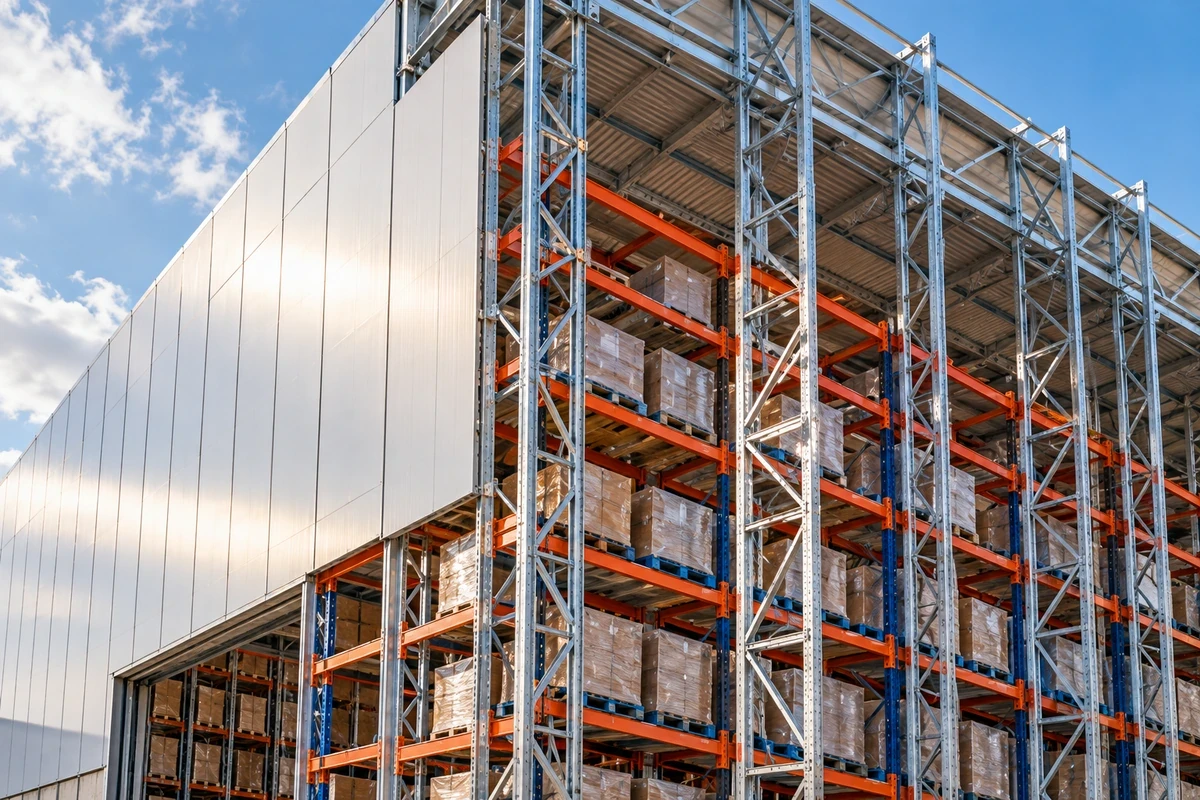
If the forklift fork enters the pallet too far, the fork tip protrudes from the back of the pallet and strikes the pallet, rack, or row spacers behind it. This contact pushes the rear pallet, deforms the beam, and can cause hidden damage to the rack upright.
The problem often appears to be operator error, but its root cause is usually an incorrectly selected fork length. When the pallet depth and fork length are mismatched, even the most careful forklift operation carries a risk during every placement.
How Far Should a Forklift Fork Enter a Pallet?
A forklift fork should enter the pallet at least two-thirds of the pallet's depth, and ideally reach full depth without its tip protruding. On a Euro pallet with a depth of 1200 mm, this means the fork should be inside approximately between 800 mm and 1200 mm.
Correct entry keeps the load's center of gravity close to the fork shank. The rated capacity of forklifts is generally specified based on a 500 mm load center distance. This distance is the length from the fork shank to the load's center of gravity.
When the fork does not enter the pallet sufficiently, the load center shifts forward and the load the forklift can carry decreases. When the fork enters too far, the load balance is not compromised, but the fork tip protrudes from the back of the pallet. Therefore, the goal is to align the fork tip with the rear edge of the pallet.
What Risks Arise When the Fork Protrudes from the Back of the Pallet?
When the fork protrudes from the back of the pallet, the greatest risk is uncontrolled contact with the pallet or rack component behind it. Risks manifest in different ways depending on the rack type and warehouse layout:
Pushing the Rear Pallet: The fork tip pushes the pallet in the opposite row, sliding it off the beam and bringing it closer to falling.
Lifting the Rear Pallet: During lifting, the fork tip enters underneath the rear pallet and partially lifts it as well.
Row Spacer Damage: Elements connecting two rack rows together bend or become detached due to the impact.
Beam Deformation: The fork striking the beam from below during lifting puts stress on the connector hooks and safety pins.
Closure of Flue Space: Pushed pallets close the clearance space left between rack rows, potentially reducing sprinkler effectiveness.
The common feature of these risks is that most of them cannot be seen by the operator. Because the fork tip remains behind the pallet, contact is only realized through sound, vibration, or damage noticed later.
What Happens When the Fork Is Shorter Than the Pallet?
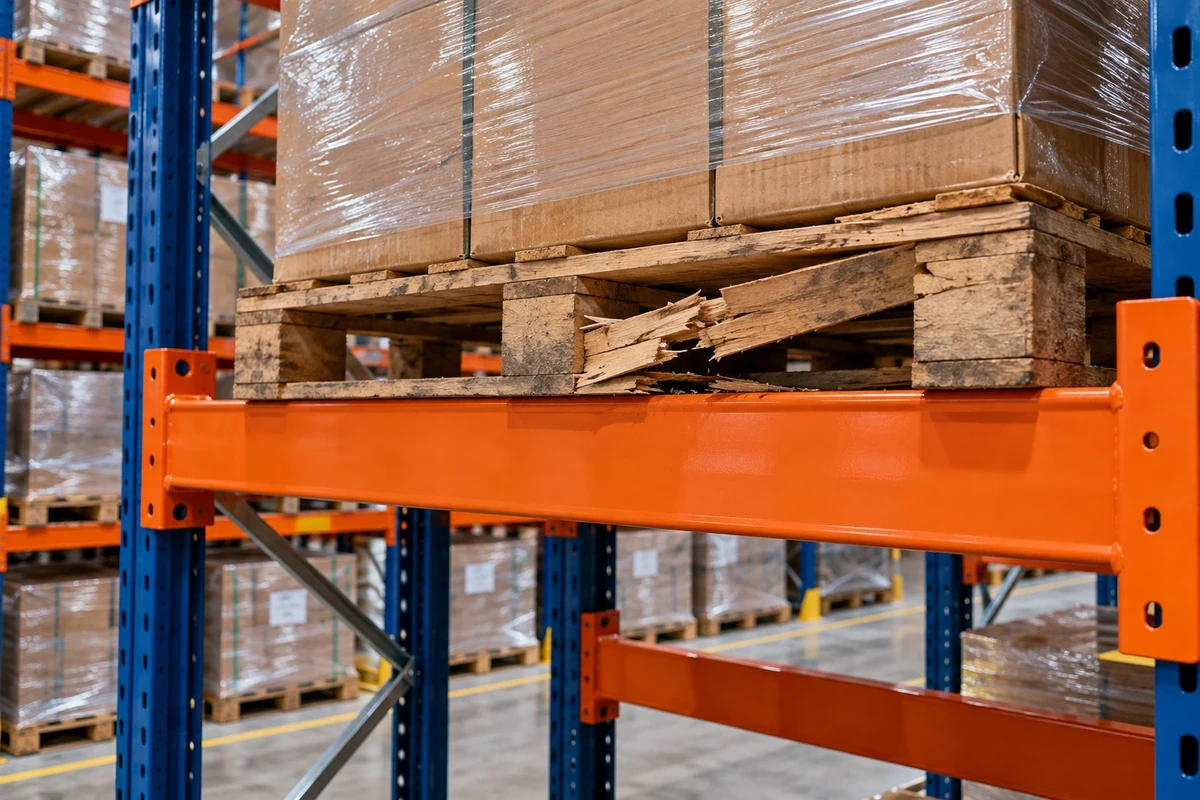
When the fork is shorter than the pallet, the pallet is not fully supported, and its rear section remains suspended beyond the fork tips. In this case, the bottom deck boards under the pallet bend, crack, or break.
A short fork brings the load's center of gravity closer to the fork tip. In heavy and high-stacked loads, the pallet tends to tip forward. Ramp transitions and sudden braking significantly increase this risk.
The problem also continues within the rack. When placing the pallet on the beams, its rear edge does not reach the desired position, leaving excessive overhang at the front. This irregular placement causes the beams to carry the load unevenly and results in pallets protruding into the aisle.
What Are Standard Forklift Fork Dimensions?
Standard forklift fork dimensions are defined by fork length, cross-section width, and cross-section thickness. The most common fork lengths are 1000, 1150, and 1200 mm. For longer loads, lengths such as 1500, 1800, and 2000 mm are also manufactured.
Forklift fork dimensions are selected along with the forklift's capacity and fork carriage class. The carriage class determines the standard height of the plate to which the fork is attached on the forklift. The table below summarizes the commonly encountered ranges by capacity:
Forklift Capacity | Carriage Class | Typical Cross-Section (Width x Thickness) | Common Fork Lengths |
|---|---|---|---|
1-2.5 tons | Class II | 100 x 40 mm | 1000-1200 mm |
2.5-4.5 tons | Class III | 120 x 45 mm | 1150-1500 mm |
4.5-5.5 tons | Class IV | 150 x 50 mm | 1200-1800 mm |
The values in the table show general trends; the exact measurement is found on the manufacturer's fork label. When selecting forklift fork dimensions, the depth of the most frequently used pallet type is taken as the baseline. For a Euro pallet and an industrial pallet with a depth of 1200 mm, an 1150 or 1200 mm fork usually provides suitable results.
Why Is Fork Length Critical in Back-to-Back and Drive-In Racks?
Fork length is critical in back-to-back and drive-in racks because another pallet or supporting rack component is located immediately behind the pallet. In a single-row rack with an open back, a protruding fork tip usually lands in empty space. In these two systems, however, there is always a target for the protrusion to strike.
A back-to-back rack system is installed by bringing two rack rows close together back-to-back. Only a narrow gap, determined by row spacers, remains between the rows. The tip of a long fork passes through this gap and pushes the pallet in the opposite row.
A drive-in rack system is a channel-type structure where the forklift enters inside the rack block. Pallets are arranged consecutively along the channel and rest on pallet support rails at the sides. A protruding fork can shift the rear pallet off the rail while placing the front pallet.
Driver visibility is also restricted in drive-in channels. The forklift moves between the uprights on both sides and behind the load. Therefore, in these systems, the compatibility between fork length and pallet depth is tested on-site prior to operation.
How to Assess Rack Damage Following Fork Contact?
Rack damage following fork contact is assessed through a systematic inspection involving visual control and measurement. A three-level risk classification is commonly used in the assessment. The process proceeds in the following order:
Securing the Area: The rack bay where the contact occurred and its surroundings are marked, and new loading is stopped.
Visual Inspection: Uprights are checked for crushing, tears, and flaking paint; beams are checked for opened connector hooks and missing safety pins.
Deflection Measurement: Upright straightness is measured with a 1-meter straightedge. The limit values taken are 5 mm in the beam direction and 3 mm in the frame direction.
Risk Classification: Damage below the limit is considered green, damage exceeding the limit is orange, and damage exceeding twice the limit is red.
Action: In orange damage, no new load is placed in the area, and repair is scheduled. In red damage, the rack bay is immediately unloaded and taken out of service.
Recording: The location of the damage, measurements, and actions taken are recorded to track recurring contact points.
A damaged upright is never straightened on-site. A bent steel profile does not regain its original strength; the damaged component is replaced with a new one.
How to Prevent Fork-Related Rack Damage?
Fork-related rack damage is prevented through the combined implementation of proper fork length, physical protection, and regular training. A single measure is usually insufficient, as the source of damage involves both equipment and operations.
Key measures include:
Pallet-Appropriate Fork Length: Forks are selected according to the predominant pallet depth in the warehouse; dedicated forklifts can be allocated for different pallets.
Pallet Backstops: Stops attached to the back of the rack bay prevent the pallet from being pushed and encroaching into the opposing row.
Upright Protectors: Protectors installed at the lower section of aisle-facing uprights absorb impact energy before it reaches the upright.
Rack Back Safety Netting: Nets installed between back-to-back rows or at the back of the rack catch falling loads.
Operator Training: Fork tip positioning, pallet depth, and lifting sequence during forklift pallet handling are taught through practical training.
Periodic Rack Inspection: Weekly visual checks and annual expert inspections ensure that minor damages are identified before they escalate.
The effectiveness of these measures reaches the highest level when evaluated together with the forklift type during the design phase of pallet rack systems. When aisle width, pallet size, and fork length are planned compatibly from the start, the risk of contact is structurally reduced.
Although a forklift fork entering a pallet too far may seem like a minor operational error, it leaves cumulative damage on the load-bearing components of the rack. Selecting a fork length suited to the pallet, properly classifying damage following contact, and utilizing physical protections halt this accumulation. Thus, the rack system safely carries its rated capacity throughout its design life.
The compatibility between fork length and pallet depth dictates most of the risks described in this article. You can explore practical applications of correct pallet placement, completed warehouse projects, and implementation examples on the RETA Mühendislik LinkedIn page.
If the forklift fork enters the pallet too far, the fork tip protrudes from the back of the pallet and strikes the pallet, rack, or row spacers behind it. This contact pushes the rear pallet, deforms the beam, and can cause hidden damage to the rack upright.
The problem often appears to be operator error, but its root cause is usually an incorrectly selected fork length. When the pallet depth and fork length are mismatched, even the most careful forklift operation carries a risk during every placement.
How Far Should a Forklift Fork Enter a Pallet?
A forklift fork should enter the pallet at least two-thirds of the pallet's depth, and ideally reach full depth without its tip protruding. On a Euro pallet with a depth of 1200 mm, this means the fork should be inside approximately between 800 mm and 1200 mm.
Correct entry keeps the load's center of gravity close to the fork shank. The rated capacity of forklifts is generally specified based on a 500 mm load center distance. This distance is the length from the fork shank to the load's center of gravity.
When the fork does not enter the pallet sufficiently, the load center shifts forward and the load the forklift can carry decreases. When the fork enters too far, the load balance is not compromised, but the fork tip protrudes from the back of the pallet. Therefore, the goal is to align the fork tip with the rear edge of the pallet.
What Risks Arise When the Fork Protrudes from the Back of the Pallet?
When the fork protrudes from the back of the pallet, the greatest risk is uncontrolled contact with the pallet or rack component behind it. Risks manifest in different ways depending on the rack type and warehouse layout:
Pushing the Rear Pallet: The fork tip pushes the pallet in the opposite row, sliding it off the beam and bringing it closer to falling.
Lifting the Rear Pallet: During lifting, the fork tip enters underneath the rear pallet and partially lifts it as well.
Row Spacer Damage: Elements connecting two rack rows together bend or become detached due to the impact.
Beam Deformation: The fork striking the beam from below during lifting puts stress on the connector hooks and safety pins.
Closure of Flue Space: Pushed pallets close the clearance space left between rack rows, potentially reducing sprinkler effectiveness.
The common feature of these risks is that most of them cannot be seen by the operator. Because the fork tip remains behind the pallet, contact is only realized through sound, vibration, or damage noticed later.
What Happens When the Fork Is Shorter Than the Pallet?
When the fork is shorter than the pallet, the pallet is not fully supported, and its rear section remains suspended beyond the fork tips. In this case, the bottom deck boards under the pallet bend, crack, or break.
A short fork brings the load's center of gravity closer to the fork tip. In heavy and high-stacked loads, the pallet tends to tip forward. Ramp transitions and sudden braking significantly increase this risk.
The problem also continues within the rack. When placing the pallet on the beams, its rear edge does not reach the desired position, leaving excessive overhang at the front. This irregular placement causes the beams to carry the load unevenly and results in pallets protruding into the aisle.
What Are Standard Forklift Fork Dimensions?
Standard forklift fork dimensions are defined by fork length, cross-section width, and cross-section thickness. The most common fork lengths are 1000, 1150, and 1200 mm. For longer loads, lengths such as 1500, 1800, and 2000 mm are also manufactured.
Forklift fork dimensions are selected along with the forklift's capacity and fork carriage class. The carriage class determines the standard height of the plate to which the fork is attached on the forklift. The table below summarizes the commonly encountered ranges by capacity:
Forklift Capacity | Carriage Class | Typical Cross-Section (Width x Thickness) | Common Fork Lengths |
|---|---|---|---|
1-2.5 tons | Class II | 100 x 40 mm | 1000-1200 mm |
2.5-4.5 tons | Class III | 120 x 45 mm | 1150-1500 mm |
4.5-5.5 tons | Class IV | 150 x 50 mm | 1200-1800 mm |
The values in the table show general trends; the exact measurement is found on the manufacturer's fork label. When selecting forklift fork dimensions, the depth of the most frequently used pallet type is taken as the baseline. For a Euro pallet and an industrial pallet with a depth of 1200 mm, an 1150 or 1200 mm fork usually provides suitable results.
Why Is Fork Length Critical in Back-to-Back and Drive-In Racks?
Fork length is critical in back-to-back and drive-in racks because another pallet or supporting rack component is located immediately behind the pallet. In a single-row rack with an open back, a protruding fork tip usually lands in empty space. In these two systems, however, there is always a target for the protrusion to strike.
A back-to-back rack system is installed by bringing two rack rows close together back-to-back. Only a narrow gap, determined by row spacers, remains between the rows. The tip of a long fork passes through this gap and pushes the pallet in the opposite row.
A drive-in rack system is a channel-type structure where the forklift enters inside the rack block. Pallets are arranged consecutively along the channel and rest on pallet support rails at the sides. A protruding fork can shift the rear pallet off the rail while placing the front pallet.
Driver visibility is also restricted in drive-in channels. The forklift moves between the uprights on both sides and behind the load. Therefore, in these systems, the compatibility between fork length and pallet depth is tested on-site prior to operation.
How to Assess Rack Damage Following Fork Contact?
Rack damage following fork contact is assessed through a systematic inspection involving visual control and measurement. A three-level risk classification is commonly used in the assessment. The process proceeds in the following order:
Securing the Area: The rack bay where the contact occurred and its surroundings are marked, and new loading is stopped.
Visual Inspection: Uprights are checked for crushing, tears, and flaking paint; beams are checked for opened connector hooks and missing safety pins.
Deflection Measurement: Upright straightness is measured with a 1-meter straightedge. The limit values taken are 5 mm in the beam direction and 3 mm in the frame direction.
Risk Classification: Damage below the limit is considered green, damage exceeding the limit is orange, and damage exceeding twice the limit is red.
Action: In orange damage, no new load is placed in the area, and repair is scheduled. In red damage, the rack bay is immediately unloaded and taken out of service.
Recording: The location of the damage, measurements, and actions taken are recorded to track recurring contact points.
A damaged upright is never straightened on-site. A bent steel profile does not regain its original strength; the damaged component is replaced with a new one.
How to Prevent Fork-Related Rack Damage?
Fork-related rack damage is prevented through the combined implementation of proper fork length, physical protection, and regular training. A single measure is usually insufficient, as the source of damage involves both equipment and operations.
Key measures include:
Pallet-Appropriate Fork Length: Forks are selected according to the predominant pallet depth in the warehouse; dedicated forklifts can be allocated for different pallets.
Pallet Backstops: Stops attached to the back of the rack bay prevent the pallet from being pushed and encroaching into the opposing row.
Upright Protectors: Protectors installed at the lower section of aisle-facing uprights absorb impact energy before it reaches the upright.
Rack Back Safety Netting: Nets installed between back-to-back rows or at the back of the rack catch falling loads.
Operator Training: Fork tip positioning, pallet depth, and lifting sequence during forklift pallet handling are taught through practical training.
Periodic Rack Inspection: Weekly visual checks and annual expert inspections ensure that minor damages are identified before they escalate.
The effectiveness of these measures reaches the highest level when evaluated together with the forklift type during the design phase of pallet rack systems. When aisle width, pallet size, and fork length are planned compatibly from the start, the risk of contact is structurally reduced.
Although a forklift fork entering a pallet too far may seem like a minor operational error, it leaves cumulative damage on the load-bearing components of the rack. Selecting a fork length suited to the pallet, properly classifying damage following contact, and utilizing physical protections halt this accumulation. Thus, the rack system safely carries its rated capacity throughout its design life.
The compatibility between fork length and pallet depth dictates most of the risks described in this article. You can explore practical applications of correct pallet placement, completed warehouse projects, and implementation examples on the RETA Mühendislik LinkedIn page.
Frequently Asked Questions (FAQ) About Forklift Forks
Frequently Asked Questions (FAQ) About Forklift Forks
Frequently Asked Questions (FAQ) About Forklift Forks
Is it safe to use fork extension sleeves?
Fork extension sleeves are safe when selected in the appropriate size and used correctly. The extension length should generally not exceed 1.5 times the length of the fork, and most of it is expected to rest on the fork. The sleeve must be secured to the fork with a locking pin. Because the extension shifts the load center forward, the forklift's load capacity decreases and this value must be recalculated.
How much wear requires a forklift fork to be replaced?
In which warehouses are telescopic forks preferred?
How should the distance between the forks be adjusted?
How often should forklift forks be inspected?

Contact
Do you want to receive more information? We have expert and reliable contact persons available for any questions, issues, and suggestions.
Reta Engineering Warehouse Racking Systems Industry and Trade Inc.
Address
Muradiye Organized Industrial Zone, 10th St. No: 30 Yunusemre / Manisa
info@retamuhendislik.com.tr