
Flow Racking Systems: FIFO-Focused High-Density Storage
Flow Racking Systems: FIFO-Focused High-Density Storage
Flow Racking Systems: FIFO-Focused High-Density Storage
Mobile shelving systems make warehouse space more efficient through FIFO-focused flow, increase picking speed, and streamline inventory management. They are an effective solution for high-density storage, controlled product flow, and safe operations.
Find answers to the question of what types of warehouses exist. Discover warehouse types based on purpose, product, construction type, and level of automation, and choose the structure that best suits your business.
Mobile shelving systems make warehouse space more efficient through FIFO-focused flow, increase picking speed, and streamline inventory management. They are an effective solution for high-density storage, controlled product flow, and safe operations.
Gravity flow rack systems are a powerful solution for businesses that want to use their warehouse space with maximum efficiency, increase order picking speed, and standardize product flow within the FIFO/LIFO logic. In this guide, we will practically and clearly address the critical points such as operating principle, types (pallet flow & carton flow), correct selection criteria, cost/ROI approach, and common mistakes.
What is a Flow Rack? How Does It Work?
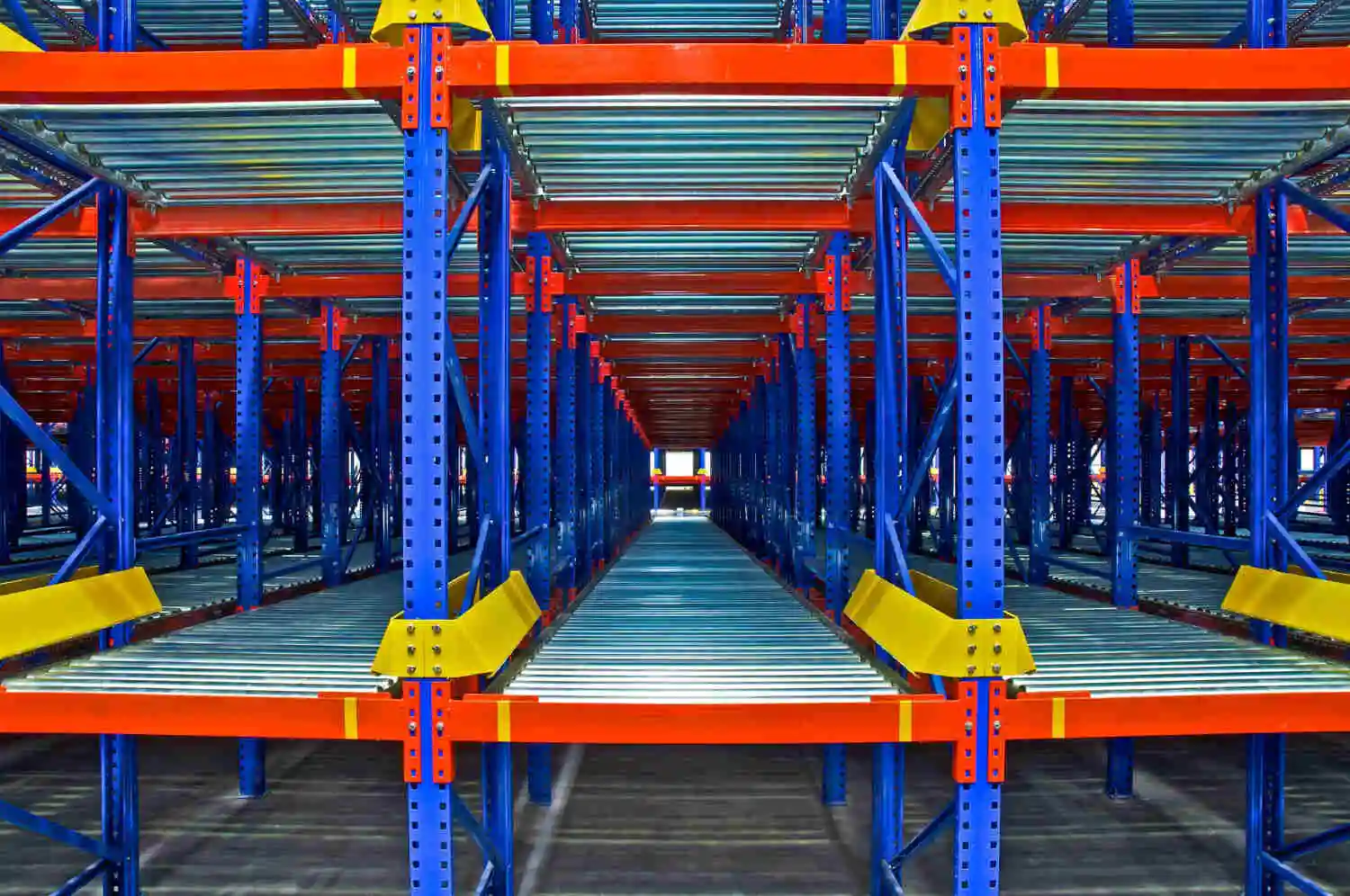
A flow rack is a high-density storage solution where products provide self-flow from front to back or back to front on sloped channels under the influence of gravity. The goal is to increase space efficiency while improving picking speed and inventory turnover.
Key Components:
Sloped channels: Lines with rollers/wheels or sliding surfaces that provide the flow of pallets or boxes.
Entry (loading) and exit (picking) side: Determines the direction of material flow.
Separator and braking modules: For controlled speed of product movement and safe separation.
Side guides and stops: Maintain linear flow and positioning.
This structure has become standard in pallet flow rack solutions used especially in high turnover palletized products, providing controlled and safe flow.
Step-by-Step Operating Principle:
Operator or forklift places products on the loading side.
The product moves towards the picking side in a controlled manner thanks to the channel slope.
As the front product is picked, those at the back automatically move forward (first-in-line logic).
Braking/separator mechanisms ensure the speed remains safe and shock-preventing.
What is FIFO? (First-In, First-Out)
The first product that enters the warehouse is the first to exit. A typical usage of flow racks is FIFO flow. Loading is done from one side, and picking is done from the other side.
When is it preferred?
Food, beverage, pharmaceuticals, cosmetics with a shelf life/expiration date
Production lines where quality and traceability are critical
High turnover SKUs in cold storage
Advantages
Maintains historical stock order, reduces risk of spoilage and expired products
Continuous accessibility in the picking line
Separation of loading and picking traffic → safer operation
Considerations
Need for double aisle (loading/unloading) in layout planning
Channel slope, pallet/package quality, and a homogeneous weight range are important
What is LIFO? (Last-In, First-Out)
The last product that enters the warehouse is the first to exit. Flow racks can also be configured as LIFO but are usually used in push-back or certain flow scenarios.
When is it preferred?
Durable products that are not critical for expiration dates
Areas where there is a single aisle operation
Limited SKU, need for fast access
Advantages
Can reduce space and aisle requirements
Simple material flow, single-sided operation
Considerations
Stock age can mix; risk for traceability and quality
Not suitable for industries where FIFO is mandatory
FIFO and LIFO: A Simple Comparison
Criteria | FIFO (Recommended) | LIFO |
Stock Age | Best control | Can mix |
Suitable Industry | Food, pharmaceuticals, fresh products | Durable products, not critical for expiration date |
Operation | Dual side (separate loading/unloading) | Single side (more compact) |
Risk | Low risk of expiry/spoilage | Higher risk of expiry |
Usage Frequency | Most common in flow racks | In special scenarios |
Advantages, Limitations, and Suitable Applications of Flow Rack Systems
Advantages
Genuine FIFO flow: Reduces wastage in products with expiration dates, strengthens traceability.
High space density: More pallet/box count compared to selective; reduces aisle numbers.
Picking speed: Products automatically come to the front; walking distance and waiting time are reduced.
Operation safety: Traffic conflicts are reduced as loading and picking sides can be separated.
Energy efficiency in cold storage: More stock in the same volume → lower door opening/closing and air loss.
Standardizable process: With ABC/slotting, flow becomes clearer for fast-cycling SKUs.
In operations requiring intense pallet flow, pallet flow rack systems significantly increase both space savings and FIFO process reliability.
Limitations
Investment cost: Initial cost is higher than selective due to dynamic channels, braking/separator modules.
Installation sensitivity: Floor flatness, channel slope, and tolerances are critical; incorrect setup disrupts the flow.
Packaging/pallet quality: Broken bottom pallets, soft cartons may cause jamming in rollers.
SKU flexibility: Optimization of channels becomes difficult in highly variable size/weight ranges.
Maintenance requirement: Periodic inspection/cleaning of rollers and separators is necessary.
Suitable Applications
Food-beverage and fresh products: FIFO mandatory; high turnover SKUs, batch/lot management.
Pharmaceuticals and cosmetics: Shelf life and traceability critical; picking accuracy prioritized.
Cold storage and frozen warehouses: High density, quick access, low energy loss.
Automotive/ancillary industries: Kanban-driven flow for line feeding; regular FIFO in small part boxes.
Retail DCs: Capacity increase for campaign/top SKUs during peak periods.
E-commerce operations: Fast picking lines with carton flow, goods-to-person station feeding.
Especially in fast-cycling box and case-based orders, carton flow rack systems shorten operator access time, increasing line/min performance.
Comparison of Flow Rack Systems with Other Warehouse Rack Systems
Selective Pallet Rack (SPR) vs Flow Rack
Access: Each pallet in SPR is directly accessible; in flow racks, the same SKU is stored in-depth, with no direct access to pallets in the back of the channel.
Density: Flow rack provides higher storage density by reducing the number of aisles.
Speed & FIFO: SPR offers more flexibility in picking; flow rack increases picking speed with FIFO discipline and automatic forward flow.
When SPR? If SKU diversity is high and quantities are low.
When Flow Rack? If SKU diversity is low/medium, high quantities, and FIFO need exist.
Push-Back Rack vs Flow Rack
Flow logic: Push-back is naturally LIFO; flow rack is mostly FIFO.
Operation: Push-back offers compact space with single aisle loading/unloading; flow rack provides higher traffic safety as loading/unloading can be separated.
Usage: Push-back is suitable if expiration date is not critical; flow rack stands out where SKU/lot tracking is needed.
Drive-In/Drive-Through vs Flow Rack
Access and risk: In drive-in, the forklift enters the rack; there is a risk of narrow space and collision. In flow rack, the forklift does not enter the channel, increasing operational safety.
Stock method: Drive-in mostly supports LIFO; flow rack naturally supports FIFO.
Efficiency: Drive-in provides high density but picking speed may decrease; flow rack offers high throughput with flow.
Pallet Shuttle (Deep Storage) vs Flow Rack
Technology: Shuttle systems work with robotic transfer in deep channels; flexibility and density are high.
Investment and maintenance: Shuttle’s initial cost and maintenance/IT requirements are high; flow rack focuses on low-maintenance mechanics.
FIFO/LIFO: Shuttle can manage both based on software/design; flow rack is a simple and proven FIFO solution.
Carton Flow (Box) vs Fixed Rack + Picking Cart
Speed: In carton flow, products automatically come forward, reducing walking distance and bending → increases line/min.
Ergonomics: Picking height and access ergonomics are better.
Investment: Initial cost is high due to dynamic channels; but can provide a fast return on investment for allocated SKUs.
Thus, it is evident that the use of carton flow rack significantly increases picking efficiency in small volume and high order frequency SKUs.
Conveyor Systems/AS/RS (Automation) vs Flow Rack
Performance: Automation (AS/RS, miniload, shuttle) offers very high throughput and traceability.
Cost and complexity: High capex, dependent on software/service. Flow rack has low complexity – high ROI balance.
Strategy: Automation for facilities with rapidly growing, 24/7 operation and very high order density; flow rack if a scalable, quickly deployable solution is needed.
Summary Table
Criteria | Flow Rack | Selective | Push-Back | Drive-In | Shuttle/ASRS |
Access | SKU based, deep channel | High (single pallet) | Medium (LIFO) | Low (LIFO) | Software dependent |
Density | High | Low-Medium | Medium-High | Very High | Very High |
FIFO Compatibility | Yes | Flexible | No (LIFO) | Generally No | Software dependent |
Throughput | High | Medium | Medium | Low-Medium | Very High |
Capex | Medium | Low | Medium | Low-Medium | High |
Maintenance/Complexity | Low-Medium | Low | Low-Medium | Low | High |
Choosing the Right System: Design & Capacity Criteria
There are points to consider when choosing the right system. It is necessary to address many different elements from the size of your warehouse to its design.
Pallet/Box Features and Channel Design
Load carrier type: EUR/EPAL 1200×800, ISO 1200×1000, plastic pallet, metal crate, box, etc. Each has different choices for roll diameter, channel width, and side guide dimensions.
Weight range: Minimum–maximum weight (e.g., 250–900 kg/pallet). If the range is wide, the number of brake module and separator increases.
Base quality: The risk of jamming increases with broken/damaged pallets; completely based (perimetric) pallets provide flow stability.
Box/carton (carton flow): Carton stiffness, base friction, and box separator configuration determine picking speed.
Slope (Pitch) and Channel Length
Typical slope: 3%–5% in pallet flow, 4%–7% in carton flow; slope can drop to 2% in very short channels.
Channel length: As depth increases, friction and speed increase; 5–8 pallet depth is a practical upper limit. 6–10 box depth is common in carton flow.
Braking & separator: Braking is essential at 3+ pallet depths. A separator at the picking end reduces operator force (makes initial pallet “removal from suspension” easier).
Width, Height, and Aisle Plan
Channel width: Ideal to add +50–100 mm allowance to pallet width (for sway and tolerances).
Tier height: Pallet height + safety margin + beam/roller structure. Waist–chest range is targeted for picking ergonomics.
Aisle width: Depends on the type of forklift used (reach, narrow aisle VNA, stacker). Priority is to separate loading and picking traffic.
Throughput (Hourly Flow) and ABC Analysis
Target throughput: Number of pallets entering/exiting per hour. The number of channels and openings determines throughput.
ABC slotting:
Class A SKU: Short, shallow channel + many openings (high speed).
Class B SKU: Medium depth + medium number of openings.
Class C SKU: Deep channel + few openings (high stock days, low speed).
Capacity Calculation (Practical Framework)
Number of pallets per channel: Channel Depth (pallet) × Number of Levels
Total capacity: Pallets per channel × Number of Channels
Example:
Channel depth: 5 pallets
Level: 4
Number of channels: 30
Capacity = 5 × 4 × 30 = 600 pallets
Carton flow example:
Depth: 8 boxes, level: 6, channel: 40 → 8 × 6 × 40 = 1,920 boxes
FIFO/LIFO Setup and Use
FIFO (recommended): Loading and picking on separate sides; ideal for expiration date and traceability.
LIFO: Possible in single side operations; compared to push-back, flow is more controlled but requires attention for stock age.
Integration: Forklift, Conveyor, Automation
Forklift compatibility: End stops, visual guides, and buffers for pallet set-down accuracy.
Conveyor/AGV integration: Low-pressure roller conveyor on the loading side, belt/roller conveyor for goods-to-person feeding on the picking side.
Sensors & WMS: Inlet occupancy sensor, WMS location management, lot/expiration date tracking.
Safety and Standards (During Selection)
Rack protection elements: Column/end protections, impact-absorbing barriers.
Fire & insurance requirements: Sprinkler overshadowing, fire curtains, height limits.
Labeling & guidance: Channel/position labels, flow direction pictograms.
Simple ROI Approach
Benefit items:
Increase in stock per m² (savings on extra rent/m²)
Decrease in picking time and walking distance (savings on labor hours)
Reduction in spoilage/expiry (especially for food/pharmaceuticals)
Form draft:
Annual Benefit ≈ (Area savings TL) + (Labor savings TL) + (Reduction in spoilage TL)
Simple Return Period (year) ≈ Total Investment / Annual Benefit
Quick Checklist (Before Selection)
Is the number of SKUs, ABC distribution, and target throughput clear?
Have the dimensions – weight – base type of pallet/box been defined?
Has the channel depth and slope simulation/trial been done?
Have loading/picking faces, forklift turns, and aisles been planned?
Have braking/separator modules and safety accessories been selected?
Have WMS labeling, expiration date/lot flow, and counting procedures been determined?
Have ROI assumptions and pilot installation with field testing been planned?
Flow Rack Systems, Maintenance, and Safety Tips
Pre-Installation Preparation
Floor levelness and load capacity: Aim for ±3 mm/10 m flatness tolerance; get static calculation for point loads.
Layout & traffic plan: Place loading and picking faces in separate aisles; mark forklift turn radii and emergency escape routes.
Pallet/box standardization: Base structure (perimetric/several beams), damage tolerance, and weight ranges must be clear.
Prototype/trial channel: Set up 1 channel for final slope and brake adjustment tests with actual pallets/boxes.
Attention During Installation
Align upright and beam: Verify with plumb and level; deviations cause slippage in the flow.
Channel slope (pitch): Usually 3%–5% for pallets; 4%–7% for carton flow. Slope difference between channels should not exceed ±0.2%.
Roller/channel connections: Bolt torque values according to manufacturer catalogs; loose connections cause vibration and noise.
Stop and side guides: Impact-absorbing stopper in the picking end; side guide to reduce sway in the channel is necessary.
Commissioning
Empty/half/full load test: Test at 3 levels; verify that brakes and separators provide controlled flow at different weights.
Operator training: Loading point, “single pallet distance” rule, procedures such as not pushing back when jammed.
WMS labeling: Flow direction pictograms, location–channel–mouth codes; barcode layout suitable for FIFO/LIFO scenarios.
Periodic Maintenance Plan
Daily (operational):
Check for foreign objects (stretch, carton residue) in the channel.
Visual inspection of stop/separators, separation of damaged pallets.
Monthly (technical):
Check if the roller turns freely, check for shaft misalignment?
Bolt/anchor torque control; looseness → sign of vibration/ringing
Check for oil/leakage/fault indication in the brake module
6-Monthly:
Re-measure and verify channel slope alignment
Column–beam alignment; check for permanent deformation after impact
Annually:
Structural inspection report (authorized/manufacturer), batch replacement of worn roller/separator sets
Check fire equipment and sprinkler access/alignment
Fault–Jamming Solution (Do & Don’t)
Do: Ensure access to the channel by emptying and controlled intervention from the opposite side; do not empty the jammed pallet from above.
Don’t: Do not push the pallet back in the channel; it damages rollers and brakes, creates chain reaction blocking with a domino effect.
Operational Safety
Impact protections: Upright foot, end protections, and corridor barriers; required at points where there is a risk of forklift collision.
Speed limit: Forklift speed limit and one-way rule in heavy traffic; do not mix loading–picking traffic.
Ergonomics: Position picking levels within waist–chest range; use platforms instead of ladders.
Visual management: Flow direction arrows, occupancy indicators, “emergency stop” procedure signs.
Cleaning and Hygiene (Especially Food/Cold Storage)
Build-up (dust, film, ice) on guides and rollers disrupts the flow; establish a weekly cleaning routine.
Condensation and icing: Confirm anti-freeze specifications for separators and brakes in cold storage from the manufacturer.
Change Management (Engineering Control)
Re-verify channel width and brake adjustment when SKU/packaging changes.
Conduct a new risk assessment when increasing depth or a new type of forklift arrives.
Gravity flow rack systems are a powerful solution for businesses that want to use their warehouse space with maximum efficiency, increase order picking speed, and standardize product flow within the FIFO/LIFO logic. In this guide, we will practically and clearly address the critical points such as operating principle, types (pallet flow & carton flow), correct selection criteria, cost/ROI approach, and common mistakes.
What is a Flow Rack? How Does It Work?
A flow rack is a high-density storage solution where products provide self-flow from front to back or back to front on sloped channels under the influence of gravity. The goal is to increase space efficiency while improving picking speed and inventory turnover.
Key Components:
Sloped channels: Lines with rollers/wheels or sliding surfaces that provide the flow of pallets or boxes.
Entry (loading) and exit (picking) side: Determines the direction of material flow.
Separator and braking modules: For controlled speed of product movement and safe separation.
Side guides and stops: Maintain linear flow and positioning.
This structure has become standard in pallet flow rack solutions used especially in high turnover palletized products, providing controlled and safe flow.
Step-by-Step Operating Principle:
Operator or forklift places products on the loading side.
The product moves towards the picking side in a controlled manner thanks to the channel slope.
As the front product is picked, those at the back automatically move forward (first-in-line logic).
Braking/separator mechanisms ensure the speed remains safe and shock-preventing.
What is FIFO? (First-In, First-Out)
The first product that enters the warehouse is the first to exit. A typical usage of flow racks is FIFO flow. Loading is done from one side, and picking is done from the other side.
When is it preferred?
Food, beverage, pharmaceuticals, cosmetics with a shelf life/expiration date
Production lines where quality and traceability are critical
High turnover SKUs in cold storage
Advantages
Maintains historical stock order, reduces risk of spoilage and expired products
Continuous accessibility in the picking line
Separation of loading and picking traffic → safer operation
Considerations
Need for double aisle (loading/unloading) in layout planning
Channel slope, pallet/package quality, and a homogeneous weight range are important
What is LIFO? (Last-In, First-Out)
The last product that enters the warehouse is the first to exit. Flow racks can also be configured as LIFO but are usually used in push-back or certain flow scenarios.
When is it preferred?
Durable products that are not critical for expiration dates
Areas where there is a single aisle operation
Limited SKU, need for fast access
Advantages
Can reduce space and aisle requirements
Simple material flow, single-sided operation
Considerations
Stock age can mix; risk for traceability and quality
Not suitable for industries where FIFO is mandatory
FIFO and LIFO: A Simple Comparison
Criteria | FIFO (Recommended) | LIFO |
Stock Age | Best control | Can mix |
Suitable Industry | Food, pharmaceuticals, fresh products | Durable products, not critical for expiration date |
Operation | Dual side (separate loading/unloading) | Single side (more compact) |
Risk | Low risk of expiry/spoilage | Higher risk of expiry |
Usage Frequency | Most common in flow racks | In special scenarios |
Advantages, Limitations, and Suitable Applications of Flow Rack Systems
Advantages
Genuine FIFO flow: Reduces wastage in products with expiration dates, strengthens traceability.
High space density: More pallet/box count compared to selective; reduces aisle numbers.
Picking speed: Products automatically come to the front; walking distance and waiting time are reduced.
Operation safety: Traffic conflicts are reduced as loading and picking sides can be separated.
Energy efficiency in cold storage: More stock in the same volume → lower door opening/closing and air loss.
Standardizable process: With ABC/slotting, flow becomes clearer for fast-cycling SKUs.
In operations requiring intense pallet flow, pallet flow rack systems significantly increase both space savings and FIFO process reliability.
Limitations
Investment cost: Initial cost is higher than selective due to dynamic channels, braking/separator modules.
Installation sensitivity: Floor flatness, channel slope, and tolerances are critical; incorrect setup disrupts the flow.
Packaging/pallet quality: Broken bottom pallets, soft cartons may cause jamming in rollers.
SKU flexibility: Optimization of channels becomes difficult in highly variable size/weight ranges.
Maintenance requirement: Periodic inspection/cleaning of rollers and separators is necessary.
Suitable Applications
Food-beverage and fresh products: FIFO mandatory; high turnover SKUs, batch/lot management.
Pharmaceuticals and cosmetics: Shelf life and traceability critical; picking accuracy prioritized.
Cold storage and frozen warehouses: High density, quick access, low energy loss.
Automotive/ancillary industries: Kanban-driven flow for line feeding; regular FIFO in small part boxes.
Retail DCs: Capacity increase for campaign/top SKUs during peak periods.
E-commerce operations: Fast picking lines with carton flow, goods-to-person station feeding.
Especially in fast-cycling box and case-based orders, carton flow rack systems shorten operator access time, increasing line/min performance.
Comparison of Flow Rack Systems with Other Warehouse Rack Systems
Selective Pallet Rack (SPR) vs Flow Rack
Access: Each pallet in SPR is directly accessible; in flow racks, the same SKU is stored in-depth, with no direct access to pallets in the back of the channel.
Density: Flow rack provides higher storage density by reducing the number of aisles.
Speed & FIFO: SPR offers more flexibility in picking; flow rack increases picking speed with FIFO discipline and automatic forward flow.
When SPR? If SKU diversity is high and quantities are low.
When Flow Rack? If SKU diversity is low/medium, high quantities, and FIFO need exist.
Push-Back Rack vs Flow Rack
Flow logic: Push-back is naturally LIFO; flow rack is mostly FIFO.
Operation: Push-back offers compact space with single aisle loading/unloading; flow rack provides higher traffic safety as loading/unloading can be separated.
Usage: Push-back is suitable if expiration date is not critical; flow rack stands out where SKU/lot tracking is needed.
Drive-In/Drive-Through vs Flow Rack
Access and risk: In drive-in, the forklift enters the rack; there is a risk of narrow space and collision. In flow rack, the forklift does not enter the channel, increasing operational safety.
Stock method: Drive-in mostly supports LIFO; flow rack naturally supports FIFO.
Efficiency: Drive-in provides high density but picking speed may decrease; flow rack offers high throughput with flow.
Pallet Shuttle (Deep Storage) vs Flow Rack
Technology: Shuttle systems work with robotic transfer in deep channels; flexibility and density are high.
Investment and maintenance: Shuttle’s initial cost and maintenance/IT requirements are high; flow rack focuses on low-maintenance mechanics.
FIFO/LIFO: Shuttle can manage both based on software/design; flow rack is a simple and proven FIFO solution.
Carton Flow (Box) vs Fixed Rack + Picking Cart
Speed: In carton flow, products automatically come forward, reducing walking distance and bending → increases line/min.
Ergonomics: Picking height and access ergonomics are better.
Investment: Initial cost is high due to dynamic channels; but can provide a fast return on investment for allocated SKUs.
Thus, it is evident that the use of carton flow rack significantly increases picking efficiency in small volume and high order frequency SKUs.
Conveyor Systems/AS/RS (Automation) vs Flow Rack
Performance: Automation (AS/RS, miniload, shuttle) offers very high throughput and traceability.
Cost and complexity: High capex, dependent on software/service. Flow rack has low complexity – high ROI balance.
Strategy: Automation for facilities with rapidly growing, 24/7 operation and very high order density; flow rack if a scalable, quickly deployable solution is needed.
Summary Table
Criteria | Flow Rack | Selective | Push-Back | Drive-In | Shuttle/ASRS |
Access | SKU based, deep channel | High (single pallet) | Medium (LIFO) | Low (LIFO) | Software dependent |
Density | High | Low-Medium | Medium-High | Very High | Very High |
FIFO Compatibility | Yes | Flexible | No (LIFO) | Generally No | Software dependent |
Throughput | High | Medium | Medium | Low-Medium | Very High |
Capex | Medium | Low | Medium | Low-Medium | High |
Maintenance/Complexity | Low-Medium | Low | Low-Medium | Low | High |
Choosing the Right System: Design & Capacity Criteria
There are points to consider when choosing the right system. It is necessary to address many different elements from the size of your warehouse to its design.
Pallet/Box Features and Channel Design
Load carrier type: EUR/EPAL 1200×800, ISO 1200×1000, plastic pallet, metal crate, box, etc. Each has different choices for roll diameter, channel width, and side guide dimensions.
Weight range: Minimum–maximum weight (e.g., 250–900 kg/pallet). If the range is wide, the number of brake module and separator increases.
Base quality: The risk of jamming increases with broken/damaged pallets; completely based (perimetric) pallets provide flow stability.
Box/carton (carton flow): Carton stiffness, base friction, and box separator configuration determine picking speed.
Slope (Pitch) and Channel Length
Typical slope: 3%–5% in pallet flow, 4%–7% in carton flow; slope can drop to 2% in very short channels.
Channel length: As depth increases, friction and speed increase; 5–8 pallet depth is a practical upper limit. 6–10 box depth is common in carton flow.
Braking & separator: Braking is essential at 3+ pallet depths. A separator at the picking end reduces operator force (makes initial pallet “removal from suspension” easier).
Width, Height, and Aisle Plan
Channel width: Ideal to add +50–100 mm allowance to pallet width (for sway and tolerances).
Tier height: Pallet height + safety margin + beam/roller structure. Waist–chest range is targeted for picking ergonomics.
Aisle width: Depends on the type of forklift used (reach, narrow aisle VNA, stacker). Priority is to separate loading and picking traffic.
Throughput (Hourly Flow) and ABC Analysis
Target throughput: Number of pallets entering/exiting per hour. The number of channels and openings determines throughput.
ABC slotting:
Class A SKU: Short, shallow channel + many openings (high speed).
Class B SKU: Medium depth + medium number of openings.
Class C SKU: Deep channel + few openings (high stock days, low speed).
Capacity Calculation (Practical Framework)
Number of pallets per channel: Channel Depth (pallet) × Number of Levels
Total capacity: Pallets per channel × Number of Channels
Example:
Channel depth: 5 pallets
Level: 4
Number of channels: 30
Capacity = 5 × 4 × 30 = 600 pallets
Carton flow example:
Depth: 8 boxes, level: 6, channel: 40 → 8 × 6 × 40 = 1,920 boxes
FIFO/LIFO Setup and Use
FIFO (recommended): Loading and picking on separate sides; ideal for expiration date and traceability.
LIFO: Possible in single side operations; compared to push-back, flow is more controlled but requires attention for stock age.
Integration: Forklift, Conveyor, Automation
Forklift compatibility: End stops, visual guides, and buffers for pallet set-down accuracy.
Conveyor/AGV integration: Low-pressure roller conveyor on the loading side, belt/roller conveyor for goods-to-person feeding on the picking side.
Sensors & WMS: Inlet occupancy sensor, WMS location management, lot/expiration date tracking.
Safety and Standards (During Selection)
Rack protection elements: Column/end protections, impact-absorbing barriers.
Fire & insurance requirements: Sprinkler overshadowing, fire curtains, height limits.
Labeling & guidance: Channel/position labels, flow direction pictograms.
Simple ROI Approach
Benefit items:
Increase in stock per m² (savings on extra rent/m²)
Decrease in picking time and walking distance (savings on labor hours)
Reduction in spoilage/expiry (especially for food/pharmaceuticals)
Form draft:
Annual Benefit ≈ (Area savings TL) + (Labor savings TL) + (Reduction in spoilage TL)
Simple Return Period (year) ≈ Total Investment / Annual Benefit
Quick Checklist (Before Selection)
Is the number of SKUs, ABC distribution, and target throughput clear?
Have the dimensions – weight – base type of pallet/box been defined?
Has the channel depth and slope simulation/trial been done?
Have loading/picking faces, forklift turns, and aisles been planned?
Have braking/separator modules and safety accessories been selected?
Have WMS labeling, expiration date/lot flow, and counting procedures been determined?
Have ROI assumptions and pilot installation with field testing been planned?
Flow Rack Systems, Maintenance, and Safety Tips
Pre-Installation Preparation
Floor levelness and load capacity: Aim for ±3 mm/10 m flatness tolerance; get static calculation for point loads.
Layout & traffic plan: Place loading and picking faces in separate aisles; mark forklift turn radii and emergency escape routes.
Pallet/box standardization: Base structure (perimetric/several beams), damage tolerance, and weight ranges must be clear.
Prototype/trial channel: Set up 1 channel for final slope and brake adjustment tests with actual pallets/boxes.
Attention During Installation
Align upright and beam: Verify with plumb and level; deviations cause slippage in the flow.
Channel slope (pitch): Usually 3%–5% for pallets; 4%–7% for carton flow. Slope difference between channels should not exceed ±0.2%.
Roller/channel connections: Bolt torque values according to manufacturer catalogs; loose connections cause vibration and noise.
Stop and side guides: Impact-absorbing stopper in the picking end; side guide to reduce sway in the channel is necessary.
Commissioning
Empty/half/full load test: Test at 3 levels; verify that brakes and separators provide controlled flow at different weights.
Operator training: Loading point, “single pallet distance” rule, procedures such as not pushing back when jammed.
WMS labeling: Flow direction pictograms, location–channel–mouth codes; barcode layout suitable for FIFO/LIFO scenarios.
Periodic Maintenance Plan
Daily (operational):
Check for foreign objects (stretch, carton residue) in the channel.
Visual inspection of stop/separators, separation of damaged pallets.
Monthly (technical):
Check if the roller turns freely, check for shaft misalignment?
Bolt/anchor torque control; looseness → sign of vibration/ringing
Check for oil/leakage/fault indication in the brake module
6-Monthly:
Re-measure and verify channel slope alignment
Column–beam alignment; check for permanent deformation after impact
Annually:
Structural inspection report (authorized/manufacturer), batch replacement of worn roller/separator sets
Check fire equipment and sprinkler access/alignment
Fault–Jamming Solution (Do & Don’t)
Do: Ensure access to the channel by emptying and controlled intervention from the opposite side; do not empty the jammed pallet from above.
Don’t: Do not push the pallet back in the channel; it damages rollers and brakes, creates chain reaction blocking with a domino effect.
Operational Safety
Impact protections: Upright foot, end protections, and corridor barriers; required at points where there is a risk of forklift collision.
Speed limit: Forklift speed limit and one-way rule in heavy traffic; do not mix loading–picking traffic.
Ergonomics: Position picking levels within waist–chest range; use platforms instead of ladders.
Visual management: Flow direction arrows, occupancy indicators, “emergency stop” procedure signs.
Cleaning and Hygiene (Especially Food/Cold Storage)
Build-up (dust, film, ice) on guides and rollers disrupts the flow; establish a weekly cleaning routine.
Condensation and icing: Confirm anti-freeze specifications for separators and brakes in cold storage from the manufacturer.
Change Management (Engineering Control)
Re-verify channel width and brake adjustment when SKU/packaging changes.
Conduct a new risk assessment when increasing depth or a new type of forklift arrives.
Frequently Asked Questions (FAQ) About RETA Racking Systems
Frequently Asked Questions (FAQ) About RETA Racking Systems
Frequently Asked Questions (FAQ) About RETA Racking Systems
How Are The Prices of RETA Racking Systems Determined?
Price; varies according to the number and depth of channels, roll/type of channel, and brake/separator modules, pallet/box size-weight range, coating (e.g. galvanization/thin film), protective equipment, floor leveling/anchoring, options such as label-sensor. Offers are usually given per channel or project-based; SKU profile, target throughput, and area plan are asked in the preliminary study.
Should You Buy Second-Hand RETA Racking? What to Pay Attention To?
Which Standards Should It Comply With? What to Consider in Terms of Fire/Sprinkler?
Is a Special Material/Coating Required in Cold Storage Application?
Delivery–How Is the Installation Process Planned?


Contact
Do you want to receive more information? We have expert and reliable contact persons available for any questions, issues, and suggestions.
Reta Engineering Warehouse Racking Systems Industry and Trade Inc.
Address
Muradiye Organized Industrial Zone, 10th St. No: 30 Yunusemre / Manisa
info@retamuhendislik.com.tr