
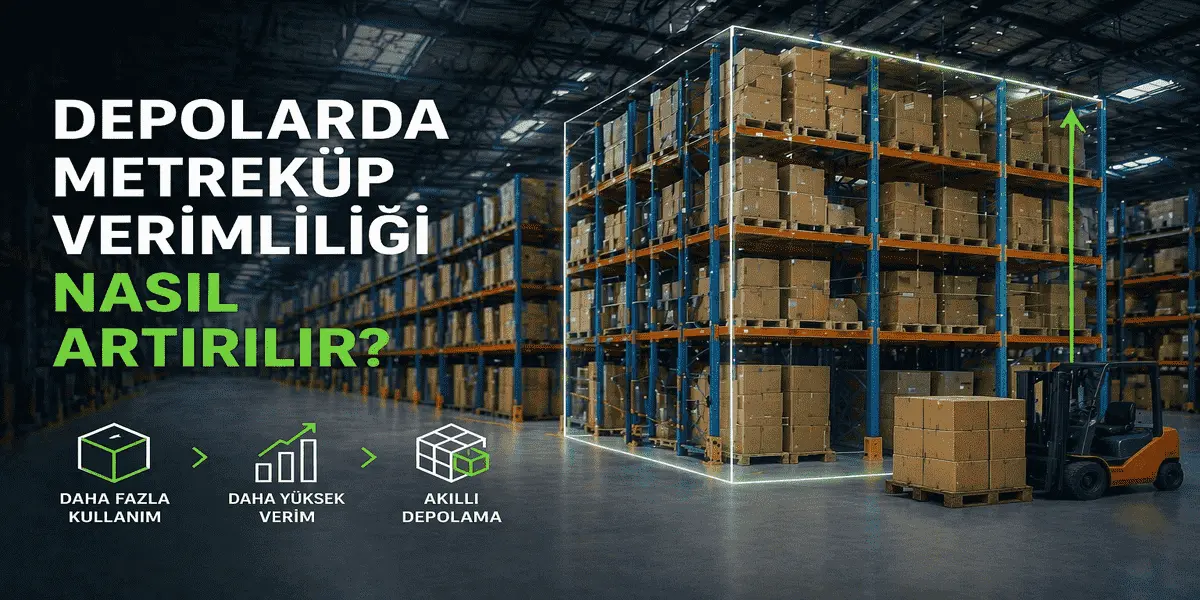
How to Increase Cubic Meter Efficiency in Warehouses?
How to Increase Cubic Meter Efficiency in Warehouses?
How to Increase Cubic Meter Efficiency in Warehouses?
Discover shelf selection, ABC analysis, vertical space utilization, and layout planning to increase cubic-meter efficiency in warehouses.
Discover shelf selection, ABC analysis, vertical space utilization, and layout planning to increase cubic-meter efficiency in warehouses.
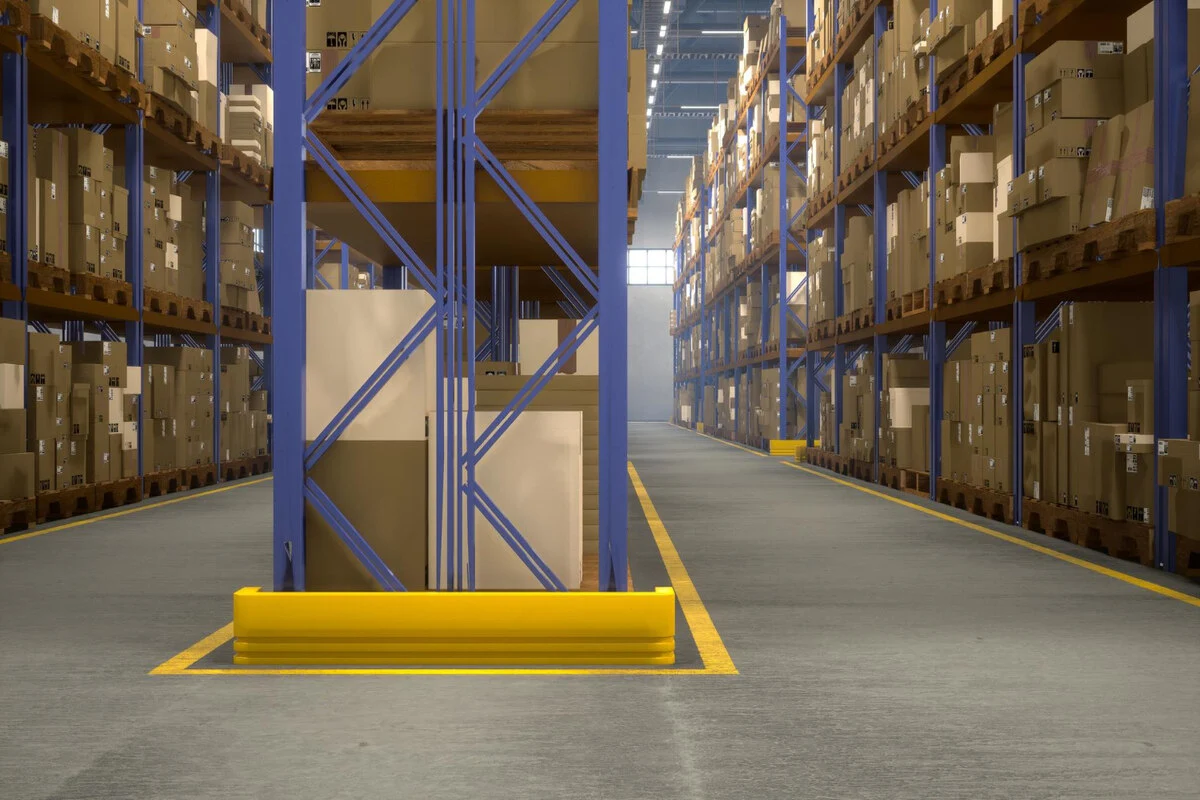
Cubic meter efficiency in warehouses is not a matter limited to storing more products within the same structure. The real issue is being able to use the available volume without slowing down operations, making product access difficult, or putting stock security at risk. A warehouse may appear physically full; however, if shelf spacing has been planned incorrectly, pallet placement is not standard, and fast-moving products are in the wrong locations, that fullness creates cost, not efficiency.
For medium and large enterprises operating in logistics, manufacturing, and retail, this issue is even more critical. Because every inefficiency in warehouse capacity means a need for additional space, more equipment use, longer picking time, and higher operating costs. Therefore, cubic meter efficiency is not only a matter for the warehouse team, but a system issue that project planning, planning, manufacturing, and operations management must address together.
Why Does Cubic Meter Efficiency in Warehouses Decrease?
In warehouses, capacity problems often stem not from a lack of space, but from the wrong use of space. Even if floor space is full, vertical volume may remain empty. Rack height may not be compatible with the product. The same product may be spread across different locations. In this case, before the warehouse grows, the warehouse layout has grown; in other words, costs increase but efficiency does not.
The main reasons that reduce cubic meter efficiency are usually the following:
Rack bays not being adjusted according to product height
Fast- and slow-moving products being placed with the same access logic
Aisle widths not being planned in line with the equipment used
Lack of standardization in pallet and carton dimensions
The same SKU being kept in multiple areas without control
Returns, quarantine stock, and slow-moving inventory occupying active space
Insufficient use of vertical volume
The fundamental mistake here is managing the warehouse only with the question, "Is there any empty space left?" The right question is: How much of the available volume is actually being converted into useful storage space? Especially the invisible losses created between racks, in pallet headspace, and in poorly designed aisle layouts generate higher costs as the warehouse gets larger.
How Is Cubic Meter Efficiency Measured in Warehouses?
Before any improvement is made, the current situation must be seen numerically. The basic calculation is as follows:
Used Storage Volume / Total Usable Volume x 100
For example, if a warehouse's total usable volume is 10,000 m³ and 6,800 m³ of it is used for active storage, the volume utilization rate is 68 percent. However, this rate alone is not sufficient. Because 68 percent utilization can be efficient with the right layout; with poor layout, it can create a capacity problem.
Therefore, the following indicators should be evaluated together:
Location occupancy rate
Fill level per pallet
Volume occupied by SKU
Order picking time
Frequency of relocation
Damage rate
How many different locations the same product is kept in
Especially in warehouses with many SKUs, cubic meter efficiency should be evaluated not only by stock quantity, but also together with stock flow. Because what fills the volume is not the number of products, but the correctly placed product structure.
How Does Vertical Space Affect Storage Capacity?
The most frequently neglected area in warehouses is the empty space near the ceiling. Many businesses try to increase floor capacity while missing the real growth opportunity in vertical volume. Yet when warehouse height is suitable, a significant capacity gain can be achieved without a new building investment by choosing the right system.
The point to note here is not simply installing taller racks. Product weight, order frequency, equipment type, and safe access must be planned together. Heavy and slow-moving products should not be stored with the same height logic as frequently moving products.
At this point, different system solutions can come into play. In carton-based operations, mezzanine systems and suspended mezzanine rack systems can increase volume utilization by turning the existing building height into a second operational level. In pallet storage, depending on product density and circulation structure, a narrow aisle rack system or denser storage solutions are evaluated. What matters here is seeing rack installation not merely as storage equipment, but as a system investment addressed together with project planning, manufacturing, assembly, and quality processes.
How Does the Right Rack System Affect Cubic Meter Efficiency?
One of the most decisive factors in cubic meter efficiency is the chosen rack structure. Because not every rack system is suitable for the same access logic, the same density level, or the same product type. Therefore, when deciding which structure to use in a warehouse, operational flow must be considered as well as capacity.
For example, in structures with a wide SKU variety and a need for direct access, a back-to-back rack system offers a common and controlled solution. In areas where the same type of palletized product must be stored at high density, a drive-in rack system can provide greater volume utilization. In scenarios requiring denser, controlled, and semi-automated flow, a shuttle rack can create a significant advantage. In operations where FIFO is important, pallet flow rack solutions are also considered.
To choose the right rack system, the following questions must be answered clearly:
Are the products moving on pallets, in cartons, or as individual units?
Is FIFO or LIFO more critical?
Are large quantities of the same SKU kept, or are there many different SKUs?
At what level is the daily inbound-outbound volume?
Which system is suitable for the existing equipment and aisle structure?
Although the wrong rack choice may seem to increase capacity in the short term, in the long run it extends picking time, increases the risk of damage, and reduces operational flexibility. Therefore, moving forward with an experienced solution partner is important for the accuracy of the investment decision.
How Do Product Placement and ABC Analysis Change Warehouse Efficiency?
Not every product in a warehouse has the same importance. Some move every day, while others stay on the rack for weeks. Yet when all products are stored with the same access logic, both time loss and volume loss occur. For this reason, ABC analysis is one of the most fundamental methods for improving cubic meter efficiency.
A-group products are the items that move most frequently and appear most often in orders. B-group products move at a medium frequency. C-group products turn more slowly. This classification should be made not only according to sales revenue, but by evaluating order line frequency, volume, and the space occupied in the warehouse together.
In the correct layout logic:
A-group products are kept in easily accessible areas
B-group products are positioned at medium access levels
C-group products are moved to higher or farther locations
In this way, the most valuable areas are allocated to the most frequently moving products. At the same time, keeping products that are ordered together close to one another reduces picking time. This approach not only increases speed; it also reduces the volume loss caused by incorrect placement.
How Should Aisle Width and Equipment Compatibility Be Planned?
Narrowing aisles to place more racks is a commonly used method. However, this decision is not right for every warehouse. Because aisle width is directly linked to the maneuverability of the equipment used. Moving to a narrow aisle without selecting the right equipment can reduce operational speed while increasing capacity.
The comparison below shows this relationship more clearly:
Observed Situation in the Warehouse | Possible Cause | Appropriate Approach |
Racks are full but picking is slow | Fast-moving products are in the wrong area | Slotting and ABC arrangement |
There is no space for new products | Rack bays are incompatible with the product | Revise location dimensions |
Capacity is low, movement area is excessive | Aisles are wider than necessary | Equipment-compatible narrow aisle plan |
Pallet count is high, occupancy is low | Unstandardized loading | Pallet and packaging standardization |
Locations change frequently | No data-based rule set | WMS or regular location management |
The right approach here is to optimize the system, not the aisle. Equipment, rack layout, and safe working space must be planned together within the warehouse. Especially in high-volume warehouses, detailed project planning carried out by an expert engineering team significantly reduces the risk of a wrong investment.
How Do Slow-Moving Inventory and Data Tracking Determine Space Usage?
The answer to why a warehouse looks full is not always active stock. In many businesses, the main burden consists of slow-moving items, returns waiting to be processed, items held in quality control, or products with unclear status. When these products are kept in the active operational area, the most valuable volume is quietly blocked.
Therefore, stock should at least be separated as follows:
Active sales stock
Slow-moving stock
Return stock
Quarantine or quality control stock
Clearance or promotional stock
Without this separation, it is difficult to make sound decisions about warehouse efficiency. Because it cannot be seen which area is truly generating work. Here, data discipline is decisive. Questions such as which product is moving how much, which location is how full, and in which area constant relocation occurs should be monitored regularly.
The key indicators that should be tracked for lasting improvement are:
Location occupancy rate
Volume utilization by SKU
Order picking time
Daily movement frequency
Damage and error rate
Frequency of location changes
Real efficiency is not merely storing more; it is being able to measure what each cubic meter is used for. That is why leading companies treat warehouse management not just as field operations, but as a data-driven decision system.
How Can the Existing Warehouse Area Be Used More Efficiently?
The first step to increasing cubic meter efficiency in warehouses is not always a new investment. Most businesses can achieve a significant capacity increase by making the right adjustments in the existing structure. For this, the existing lost areas should be assessed first, then the wrong layout decisions, and finally the physical system needs.
A practical improvement approach proceeds in the following order:
Measure the current volume utilization
Classify products according to movement speed
Separate slow-moving stock from the active area
Match rack bays with product dimensions
Review pallet and packaging standards
Reassess aisle and equipment compatibility
Redesign the space with the appropriate rack system if necessary
This sequence matters. Because in most cases, the problem is not building insufficiency, but a disorganized existing system. A properly planned warehouse operates more safely, faster, and at lower cost. If you are aiming to increase capacity in your current warehouse structure, start by evaluating the layout design and volume utilization rates together.
Cubic meter efficiency in warehouses is not a matter limited to storing more products within the same structure. The real issue is being able to use the available volume without slowing down operations, making product access difficult, or putting stock security at risk. A warehouse may appear physically full; however, if shelf spacing has been planned incorrectly, pallet placement is not standard, and fast-moving products are in the wrong locations, that fullness creates cost, not efficiency.
For medium and large enterprises operating in logistics, manufacturing, and retail, this issue is even more critical. Because every inefficiency in warehouse capacity means a need for additional space, more equipment use, longer picking time, and higher operating costs. Therefore, cubic meter efficiency is not only a matter for the warehouse team, but a system issue that project planning, planning, manufacturing, and operations management must address together.
Why Does Cubic Meter Efficiency in Warehouses Decrease?
In warehouses, capacity problems often stem not from a lack of space, but from the wrong use of space. Even if floor space is full, vertical volume may remain empty. Rack height may not be compatible with the product. The same product may be spread across different locations. In this case, before the warehouse grows, the warehouse layout has grown; in other words, costs increase but efficiency does not.
The main reasons that reduce cubic meter efficiency are usually the following:
Rack bays not being adjusted according to product height
Fast- and slow-moving products being placed with the same access logic
Aisle widths not being planned in line with the equipment used
Lack of standardization in pallet and carton dimensions
The same SKU being kept in multiple areas without control
Returns, quarantine stock, and slow-moving inventory occupying active space
Insufficient use of vertical volume
The fundamental mistake here is managing the warehouse only with the question, "Is there any empty space left?" The right question is: How much of the available volume is actually being converted into useful storage space? Especially the invisible losses created between racks, in pallet headspace, and in poorly designed aisle layouts generate higher costs as the warehouse gets larger.
How Is Cubic Meter Efficiency Measured in Warehouses?
Before any improvement is made, the current situation must be seen numerically. The basic calculation is as follows:
Used Storage Volume / Total Usable Volume x 100
For example, if a warehouse's total usable volume is 10,000 m³ and 6,800 m³ of it is used for active storage, the volume utilization rate is 68 percent. However, this rate alone is not sufficient. Because 68 percent utilization can be efficient with the right layout; with poor layout, it can create a capacity problem.
Therefore, the following indicators should be evaluated together:
Location occupancy rate
Fill level per pallet
Volume occupied by SKU
Order picking time
Frequency of relocation
Damage rate
How many different locations the same product is kept in
Especially in warehouses with many SKUs, cubic meter efficiency should be evaluated not only by stock quantity, but also together with stock flow. Because what fills the volume is not the number of products, but the correctly placed product structure.
How Does Vertical Space Affect Storage Capacity?
The most frequently neglected area in warehouses is the empty space near the ceiling. Many businesses try to increase floor capacity while missing the real growth opportunity in vertical volume. Yet when warehouse height is suitable, a significant capacity gain can be achieved without a new building investment by choosing the right system.
The point to note here is not simply installing taller racks. Product weight, order frequency, equipment type, and safe access must be planned together. Heavy and slow-moving products should not be stored with the same height logic as frequently moving products.
At this point, different system solutions can come into play. In carton-based operations, mezzanine systems and suspended mezzanine rack systems can increase volume utilization by turning the existing building height into a second operational level. In pallet storage, depending on product density and circulation structure, a narrow aisle rack system or denser storage solutions are evaluated. What matters here is seeing rack installation not merely as storage equipment, but as a system investment addressed together with project planning, manufacturing, assembly, and quality processes.
How Does the Right Rack System Affect Cubic Meter Efficiency?
One of the most decisive factors in cubic meter efficiency is the chosen rack structure. Because not every rack system is suitable for the same access logic, the same density level, or the same product type. Therefore, when deciding which structure to use in a warehouse, operational flow must be considered as well as capacity.
For example, in structures with a wide SKU variety and a need for direct access, a back-to-back rack system offers a common and controlled solution. In areas where the same type of palletized product must be stored at high density, a drive-in rack system can provide greater volume utilization. In scenarios requiring denser, controlled, and semi-automated flow, a shuttle rack can create a significant advantage. In operations where FIFO is important, pallet flow rack solutions are also considered.
To choose the right rack system, the following questions must be answered clearly:
Are the products moving on pallets, in cartons, or as individual units?
Is FIFO or LIFO more critical?
Are large quantities of the same SKU kept, or are there many different SKUs?
At what level is the daily inbound-outbound volume?
Which system is suitable for the existing equipment and aisle structure?
Although the wrong rack choice may seem to increase capacity in the short term, in the long run it extends picking time, increases the risk of damage, and reduces operational flexibility. Therefore, moving forward with an experienced solution partner is important for the accuracy of the investment decision.
How Do Product Placement and ABC Analysis Change Warehouse Efficiency?
Not every product in a warehouse has the same importance. Some move every day, while others stay on the rack for weeks. Yet when all products are stored with the same access logic, both time loss and volume loss occur. For this reason, ABC analysis is one of the most fundamental methods for improving cubic meter efficiency.
A-group products are the items that move most frequently and appear most often in orders. B-group products move at a medium frequency. C-group products turn more slowly. This classification should be made not only according to sales revenue, but by evaluating order line frequency, volume, and the space occupied in the warehouse together.
In the correct layout logic:
A-group products are kept in easily accessible areas
B-group products are positioned at medium access levels
C-group products are moved to higher or farther locations
In this way, the most valuable areas are allocated to the most frequently moving products. At the same time, keeping products that are ordered together close to one another reduces picking time. This approach not only increases speed; it also reduces the volume loss caused by incorrect placement.
How Should Aisle Width and Equipment Compatibility Be Planned?
Narrowing aisles to place more racks is a commonly used method. However, this decision is not right for every warehouse. Because aisle width is directly linked to the maneuverability of the equipment used. Moving to a narrow aisle without selecting the right equipment can reduce operational speed while increasing capacity.
The comparison below shows this relationship more clearly:
Observed Situation in the Warehouse | Possible Cause | Appropriate Approach |
Racks are full but picking is slow | Fast-moving products are in the wrong area | Slotting and ABC arrangement |
There is no space for new products | Rack bays are incompatible with the product | Revise location dimensions |
Capacity is low, movement area is excessive | Aisles are wider than necessary | Equipment-compatible narrow aisle plan |
Pallet count is high, occupancy is low | Unstandardized loading | Pallet and packaging standardization |
Locations change frequently | No data-based rule set | WMS or regular location management |
The right approach here is to optimize the system, not the aisle. Equipment, rack layout, and safe working space must be planned together within the warehouse. Especially in high-volume warehouses, detailed project planning carried out by an expert engineering team significantly reduces the risk of a wrong investment.
How Do Slow-Moving Inventory and Data Tracking Determine Space Usage?
The answer to why a warehouse looks full is not always active stock. In many businesses, the main burden consists of slow-moving items, returns waiting to be processed, items held in quality control, or products with unclear status. When these products are kept in the active operational area, the most valuable volume is quietly blocked.
Therefore, stock should at least be separated as follows:
Active sales stock
Slow-moving stock
Return stock
Quarantine or quality control stock
Clearance or promotional stock
Without this separation, it is difficult to make sound decisions about warehouse efficiency. Because it cannot be seen which area is truly generating work. Here, data discipline is decisive. Questions such as which product is moving how much, which location is how full, and in which area constant relocation occurs should be monitored regularly.
The key indicators that should be tracked for lasting improvement are:
Location occupancy rate
Volume utilization by SKU
Order picking time
Daily movement frequency
Damage and error rate
Frequency of location changes
Real efficiency is not merely storing more; it is being able to measure what each cubic meter is used for. That is why leading companies treat warehouse management not just as field operations, but as a data-driven decision system.
How Can the Existing Warehouse Area Be Used More Efficiently?
The first step to increasing cubic meter efficiency in warehouses is not always a new investment. Most businesses can achieve a significant capacity increase by making the right adjustments in the existing structure. For this, the existing lost areas should be assessed first, then the wrong layout decisions, and finally the physical system needs.
A practical improvement approach proceeds in the following order:
Measure the current volume utilization
Classify products according to movement speed
Separate slow-moving stock from the active area
Match rack bays with product dimensions
Review pallet and packaging standards
Reassess aisle and equipment compatibility
Redesign the space with the appropriate rack system if necessary
This sequence matters. Because in most cases, the problem is not building insufficiency, but a disorganized existing system. A properly planned warehouse operates more safely, faster, and at lower cost. If you are aiming to increase capacity in your current warehouse structure, start by evaluating the layout design and volume utilization rates together.
Frequently Asked Questions (FAQ) About Cubic Meter Efficiency in Warehouses
Frequently Asked Questions (FAQ) About Cubic Meter Efficiency in Warehouses
Frequently Asked Questions (FAQ) About Cubic Meter Efficiency in Warehouses
At Which Points Does the Greatest Space Loss Occur in the Warehouse?
The biggest losses usually occur in shelf gaps, empty spaces on pallets, incorrect location usage, and slow-moving inventory occupying active space.
In Which Situations Should a Shelving System Revision Be Made Instead of a New Warehouse Investment?
Which approach is more suitable in warehouses where FIFO is required?
How Can Vertical Space Be Used More Efficiently in Case-Based Storage?
Why Can Operational Speed Decrease as Cubic Meter Efficiency Increases?

Contact
Do you want to receive more information? We have expert and reliable contact persons available for any questions, issues, and suggestions.
Reta Engineering Warehouse Racking Systems Industry and Trade Inc.
Address
Muradiye Organized Industrial Zone, 10th St. No: 30 Yunusemre / Manisa
info@retamuhendislik.com.tr