
Can a Damaged Pallet Jeopardize a Sound Rack?
Can a Damaged Pallet Jeopardize a Sound Rack?
Can a Damaged Pallet Jeopardize a Sound Rack?
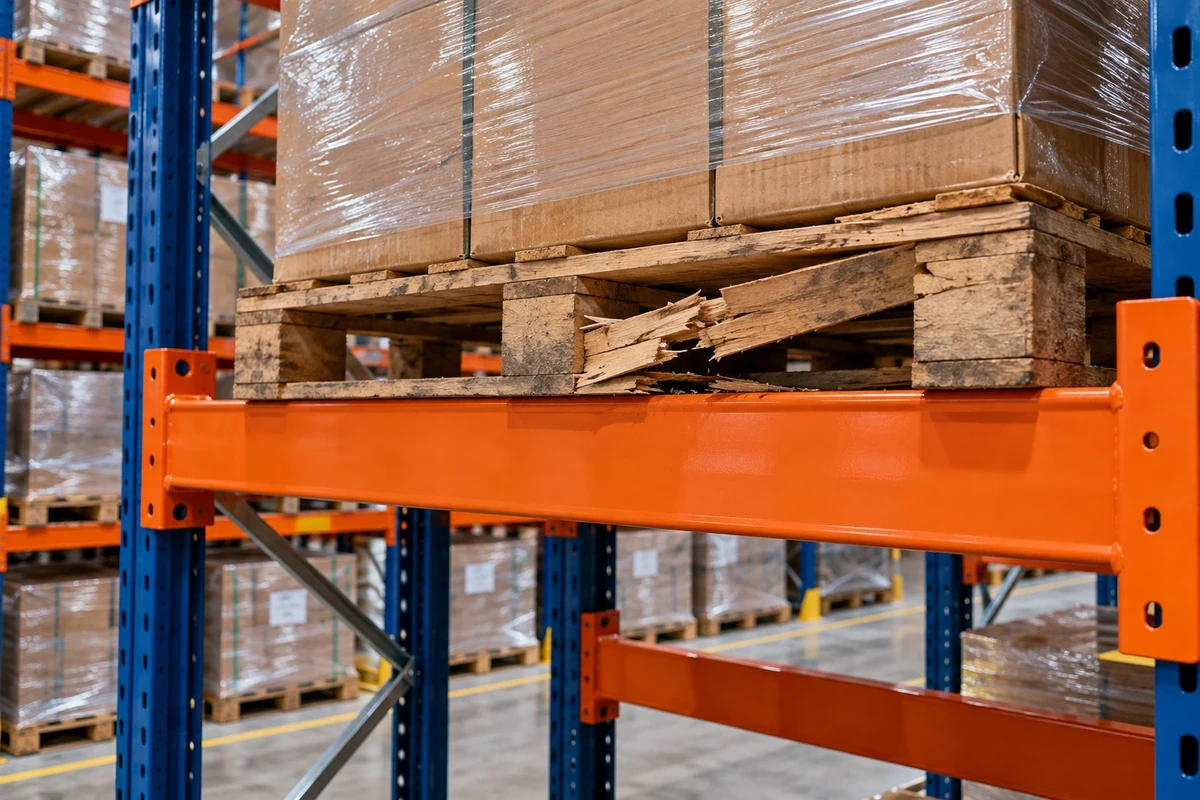
A damaged pallet also endangers a sturdy rack. Rack calculations rely on the even transfer of the load to the beams through an intact pallet; a broken bottom board or a crushed block breaks this bridge, causing the pallet to collapse or fall. A visual inspection before placement and a designated area for damaged pallets are essential.
Can a broken pallet endanger a sturdy rack? Pallet damage types, pre-placement inspection, seating on the beam, and precautions for warehouse safety.
A damaged pallet also endangers a sturdy rack. Rack calculations rely on the even transfer of the load to the beams through an intact pallet; a broken bottom board or a crushed block breaks this bridge, causing the pallet to collapse or fall. A visual inspection before placement and a designated area for damaged pallets are essential.

Yes, a damaged pallet can compromise a completely sound rack. The rack is designed so that the load is transferred to the beams via the pallet's bottom deckboards. When one of these boards breaks, the load is distributed unevenly and the pallet can fall through the rack bay.
Calculations for racking systems are based on the assumption that the load arrives on a uniform and sound carrier. A broken pallet invalidates this assumption. Therefore, the pallet is as critical a structural element in warehouse safety as the rack itself.
How Does a Damaged Pallet Affect Rack Safety?
A damaged pallet affects rack safety by altering the way the load is transferred to the rack bay. A sound pallet transmits the load to the two beams equally and uniformly. A broken pallet, however, concentrates the load at a single point or begins to sag between the beams.
Pallet racking systems mostly operate with pallets resting directly on the beams. In these systems, there is no additional supporting surface underneath the pallet. The section of the pallet spanning the two beams bridges the load via its own load-bearing boards.
When this bridge is compromised, three outcomes emerge. The pallet sags in the center and the load shifts forward or backward. The concentrated point load placed on a single beam causes unexpected deflection in the beam. In the worst-case scenario, the pallet drops between the two beams into the lower bay or aisle.
What Are the Most Common Types of Pallet Damage?
A pallet consists of top deckboards, bottom deckboards, blocks, and the fasteners that hold them together. Damage presents itself differently in each of these components:
Broken Top Deckboard: The load-bearing surface is compromised; boxes or bags sink into the gap, leading to uneven loading.
Broken or Missing Bottom Deckboard: The surface where the pallet rests on the beam is weakened; this is the most critical damage in terms of rack safety.
Crushed or Cracked Block: The pallet dips at one corner, causing the load to tilt sideways.
Protruding Nail: Damages forklift tines, packaging, and personnel; halts flow in roller systems.
Camber and Permanent Deflection: A pallet subjected to excessive loads for long periods loses its shape and fails to seat properly on the beams.
Moisture, Mold, and Rot: The strength of the wood decreases, and connection points loosen over time.
Most of this damage is caused by forklift tines impacting the pallet or entering at an incorrect angle. Excessive loads placed on the bottom pallet during pallet stacking are also a common cause of crushed blocks.
Which Pallet Damages Prevent Rack Placement?
Any damage that compromises the bottom structure resting on the beam or the structural integrity of the pallet prevents rack placement. Superficial scratches and minor splinters generally do not halt use. The following table summarizes the impact of common damage on the rack and the expected decision:
Damage Type | Effect on Rack | Decision |
|---|---|---|
Bottom deckboard broken or missing | Pallet sags between beams, risk of falling occurs | Do not rack |
Block crushed, cracked, or missing | Load shifts to one corner, places unbalanced load on beam | Do not rack |
Multiple top deckboards broken | Load collapses, pallet balance is disrupted | Do not rack |
Noticeable camber or deflection | Pallet does not seat fully on the beam | Do not rack |
Protruding nail | Jamming on roller lanes, packaging damage | Use after repair |
Minor crack in a single top deckboard | Limited effect | Use with monitoring if load is light |
Superficial splinter or scratch | No structural effect | Usable |
Damage tolerance also varies depending on the rack type. In pallet flow racking systems, the pallet moves by gravity on inclined rollers. In these systems, even a bottom deckboard defect that would not cause issues in a standard rack can lead to the pallet getting stuck inside the lane.
How to Inspect a Pallet Before Placing It in a Rack?
Before a pallet is placed in a rack, it is subjected to a brief visual inspection starting from the bottom structure up to the load itself. The order of inspection ensures that the most critical damage is caught at first glance:
Bottom Deckboards: Lift the pallet slightly to check for broken, missing, or cracked bottom deckboards.
Blocks: Inspect corner and center blocks for crushing, splitting, and loosening.
Top Deckboards: Check the surface where the load sits for breakage, splitting, and sagging.
Fasteners: Check for protruding nails, loosened screws, or severed connection hardware.
Overall Shape: Check whether the pallet rests on all four corners on a flat surface and whether there is any warping or deflection.
Load Compatibility: Verify that the load remains within the boundaries of the pallet and that the weight does not exceed the value on the rack bay label.
A pallet that fails the inspection is kept in a separate area until the load is transferred to a sound pallet. This area is marked in a way that prevents damaged pallets from mistakenly re-entering dispatch.
How Should a Pallet Sit on Beams?
The pallet should sit with its bottom deckboards perpendicular to the beams, with equal overhang on the front and rear beams. In this arrangement, the bottom deckboards bridge the two beams. The load is also distributed approximately equally between both beams.
The amount of pallet overhang from the beams is generally kept at around 50–100 mm on both sides. A pallet that extends too far forward becomes vulnerable to forklift impacts and overloads the front beam. A pallet that sits too far back carries the risk of slipping off the rear beam.
The orientation of the pallet is also decisive. A pallet placed with its bottom deckboards parallel to the beams can fall through between the beams. If storage in this orientation is necessary, pallet support bars or wire decking are added to the rack bay.
Clearance is also left between adjacent pallets and uprights. This distance is generally in the range of 75–100 mm and ensures the forklift can place loads without striking the uprights.
Can a Repaired Pallet Be Safely Used in a Rack?
A repaired pallet can be safely used in a rack if it has been repaired in accordance with original dimensions, materials, and connection quality. The boards and blocks used in the repair must have the same dimensions and strength as the original pallet components.
The fundamental criterion of safe repair is that the bottom geometry of the pallet does not change. Nailing an additional board over a broken board or adding pieces next to a block alters this geometry. Such a pallet will not seat properly on the beams and will cause jams in roller systems.
In standard pallet pools, repairs are carried out in authorized workshops according to established rules. Pallets repaired in compliance with these rules are re-marked and returned to service. Random, substandard repairs, on the other hand, result in a pallet with unknown load-bearing capacity.
What Measures Can Reduce Pallet-Related Risks in Racks?
Pallet-related risks are reduced by applying several complementary measures, ranging from pallet acceptance to rack design. Key measures include:
Inbound Receiving Inspection: Pallets arriving from suppliers are inspected for damage before being taken into the warehouse.
Damaged Pallet Area: A designated and segregated holding area is created for pallets that fail inspection.
Pallet Support Bars and Decking: In warehouses where different pallet types are used, an additional load-bearing surface is added to the rack bay.
Load Notice Signs: The permissible load of each rack bay is clearly indicated to prevent overloading.
Rear Safety Netting: Nets attached to the back of the rack catch sliding or falling loads before they reach the aisle.
Forklift Operator Training: Proper tine entry during pallet loading and identifying damaged pallets are taught practically.
These measures are complementary layers that prevent pallet damage from turning into rack damage. Skipping a single layer increases the burden on the others.
A damaged pallet silently consumes the safety factor of a sound and properly engineered rack. Inspecting pallets, seating them correctly on beams, and segregating damaged ones ensures the racking system operates at its designed capacity. Warehouse safety becomes holistic when the rack and the pallet are treated as parts of the same system.
Yes, a damaged pallet can compromise a completely sound rack. The rack is designed so that the load is transferred to the beams via the pallet's bottom deckboards. When one of these boards breaks, the load is distributed unevenly and the pallet can fall through the rack bay.
Calculations for racking systems are based on the assumption that the load arrives on a uniform and sound carrier. A broken pallet invalidates this assumption. Therefore, the pallet is as critical a structural element in warehouse safety as the rack itself.
How Does a Damaged Pallet Affect Rack Safety?
A damaged pallet affects rack safety by altering the way the load is transferred to the rack bay. A sound pallet transmits the load to the two beams equally and uniformly. A broken pallet, however, concentrates the load at a single point or begins to sag between the beams.
Pallet racking systems mostly operate with pallets resting directly on the beams. In these systems, there is no additional supporting surface underneath the pallet. The section of the pallet spanning the two beams bridges the load via its own load-bearing boards.
When this bridge is compromised, three outcomes emerge. The pallet sags in the center and the load shifts forward or backward. The concentrated point load placed on a single beam causes unexpected deflection in the beam. In the worst-case scenario, the pallet drops between the two beams into the lower bay or aisle.
What Are the Most Common Types of Pallet Damage?
A pallet consists of top deckboards, bottom deckboards, blocks, and the fasteners that hold them together. Damage presents itself differently in each of these components:
Broken Top Deckboard: The load-bearing surface is compromised; boxes or bags sink into the gap, leading to uneven loading.
Broken or Missing Bottom Deckboard: The surface where the pallet rests on the beam is weakened; this is the most critical damage in terms of rack safety.
Crushed or Cracked Block: The pallet dips at one corner, causing the load to tilt sideways.
Protruding Nail: Damages forklift tines, packaging, and personnel; halts flow in roller systems.
Camber and Permanent Deflection: A pallet subjected to excessive loads for long periods loses its shape and fails to seat properly on the beams.
Moisture, Mold, and Rot: The strength of the wood decreases, and connection points loosen over time.
Most of this damage is caused by forklift tines impacting the pallet or entering at an incorrect angle. Excessive loads placed on the bottom pallet during pallet stacking are also a common cause of crushed blocks.
Which Pallet Damages Prevent Rack Placement?
Any damage that compromises the bottom structure resting on the beam or the structural integrity of the pallet prevents rack placement. Superficial scratches and minor splinters generally do not halt use. The following table summarizes the impact of common damage on the rack and the expected decision:
Damage Type | Effect on Rack | Decision |
|---|---|---|
Bottom deckboard broken or missing | Pallet sags between beams, risk of falling occurs | Do not rack |
Block crushed, cracked, or missing | Load shifts to one corner, places unbalanced load on beam | Do not rack |
Multiple top deckboards broken | Load collapses, pallet balance is disrupted | Do not rack |
Noticeable camber or deflection | Pallet does not seat fully on the beam | Do not rack |
Protruding nail | Jamming on roller lanes, packaging damage | Use after repair |
Minor crack in a single top deckboard | Limited effect | Use with monitoring if load is light |
Superficial splinter or scratch | No structural effect | Usable |
Damage tolerance also varies depending on the rack type. In pallet flow racking systems, the pallet moves by gravity on inclined rollers. In these systems, even a bottom deckboard defect that would not cause issues in a standard rack can lead to the pallet getting stuck inside the lane.
How to Inspect a Pallet Before Placing It in a Rack?
Before a pallet is placed in a rack, it is subjected to a brief visual inspection starting from the bottom structure up to the load itself. The order of inspection ensures that the most critical damage is caught at first glance:
Bottom Deckboards: Lift the pallet slightly to check for broken, missing, or cracked bottom deckboards.
Blocks: Inspect corner and center blocks for crushing, splitting, and loosening.
Top Deckboards: Check the surface where the load sits for breakage, splitting, and sagging.
Fasteners: Check for protruding nails, loosened screws, or severed connection hardware.
Overall Shape: Check whether the pallet rests on all four corners on a flat surface and whether there is any warping or deflection.
Load Compatibility: Verify that the load remains within the boundaries of the pallet and that the weight does not exceed the value on the rack bay label.
A pallet that fails the inspection is kept in a separate area until the load is transferred to a sound pallet. This area is marked in a way that prevents damaged pallets from mistakenly re-entering dispatch.
How Should a Pallet Sit on Beams?
The pallet should sit with its bottom deckboards perpendicular to the beams, with equal overhang on the front and rear beams. In this arrangement, the bottom deckboards bridge the two beams. The load is also distributed approximately equally between both beams.
The amount of pallet overhang from the beams is generally kept at around 50–100 mm on both sides. A pallet that extends too far forward becomes vulnerable to forklift impacts and overloads the front beam. A pallet that sits too far back carries the risk of slipping off the rear beam.
The orientation of the pallet is also decisive. A pallet placed with its bottom deckboards parallel to the beams can fall through between the beams. If storage in this orientation is necessary, pallet support bars or wire decking are added to the rack bay.
Clearance is also left between adjacent pallets and uprights. This distance is generally in the range of 75–100 mm and ensures the forklift can place loads without striking the uprights.
Can a Repaired Pallet Be Safely Used in a Rack?
A repaired pallet can be safely used in a rack if it has been repaired in accordance with original dimensions, materials, and connection quality. The boards and blocks used in the repair must have the same dimensions and strength as the original pallet components.
The fundamental criterion of safe repair is that the bottom geometry of the pallet does not change. Nailing an additional board over a broken board or adding pieces next to a block alters this geometry. Such a pallet will not seat properly on the beams and will cause jams in roller systems.
In standard pallet pools, repairs are carried out in authorized workshops according to established rules. Pallets repaired in compliance with these rules are re-marked and returned to service. Random, substandard repairs, on the other hand, result in a pallet with unknown load-bearing capacity.
What Measures Can Reduce Pallet-Related Risks in Racks?
Pallet-related risks are reduced by applying several complementary measures, ranging from pallet acceptance to rack design. Key measures include:
Inbound Receiving Inspection: Pallets arriving from suppliers are inspected for damage before being taken into the warehouse.
Damaged Pallet Area: A designated and segregated holding area is created for pallets that fail inspection.
Pallet Support Bars and Decking: In warehouses where different pallet types are used, an additional load-bearing surface is added to the rack bay.
Load Notice Signs: The permissible load of each rack bay is clearly indicated to prevent overloading.
Rear Safety Netting: Nets attached to the back of the rack catch sliding or falling loads before they reach the aisle.
Forklift Operator Training: Proper tine entry during pallet loading and identifying damaged pallets are taught practically.
These measures are complementary layers that prevent pallet damage from turning into rack damage. Skipping a single layer increases the burden on the others.
A damaged pallet silently consumes the safety factor of a sound and properly engineered rack. Inspecting pallets, seating them correctly on beams, and segregating damaged ones ensures the racking system operates at its designed capacity. Warehouse safety becomes holistic when the rack and the pallet are treated as parts of the same system.
Frequently Asked Questions (FAQ) About Damaged Pallets
Frequently Asked Questions (FAQ) About Damaged Pallets
Frequently Asked Questions (FAQ) About Damaged Pallets
What happens if the pallet load capacity is lower than the rack compartment capacity?
If the carrying capacity of the pallet is lower than the rack compartment capacity, the allowable load is determined based on the pallet. The weakest element in the system defines the safety limit. The capacity of a pallet suspended on a rack is generally lower than the capacity of the same pallet sitting on the ground. For this reason, the value specified for racking on the pallet label is also checked.
How often should pallet inspection be performed?
Where should the damaged pallet be kept in the warehouse?
What happens if the load on the pallet overhangs the pallet?
Does stretch film wrapping affect shelf safety?


Contact
Do you want to receive more information? We have expert and reliable contact persons available for any questions, issues, and suggestions.
Reta Engineering Warehouse Racking Systems Industry and Trade Inc.
Address
Muradiye Organized Industrial Zone, 10th St. No: 30 Yunusemre / Manisa
info@retamuhendislik.com.tr