
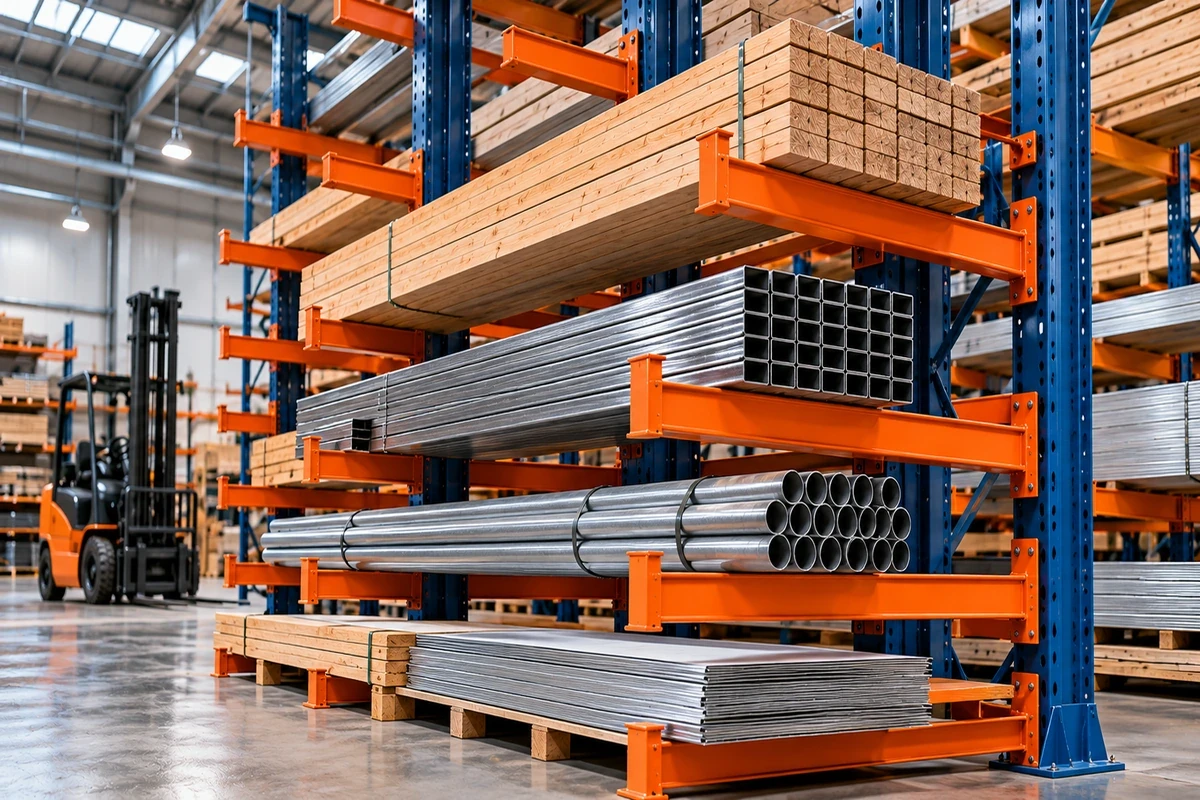
How to Determine Cantilever Rack Arm Length?
How to Determine Cantilever Rack Arm Length?
How to Determine Cantilever Rack Arm Length?
Cantilever rack arm length is determined by adding a 50-100 mm clearance to the material depth and rounding to the standard length. Since the arm acts as a cantilever beam, the moment at the base increases as the load shifts toward the tip. A short arm causes tipping, while a long arm leads to capacity loss; arm spacing and forklift reach are also decisive.
Cantilever rack arm length is determined according to material depth, load center, and handling equipment. Calculation logic, arm spacing, and selection based on the material.
Cantilever rack arm length is determined by adding a 50-100 mm clearance to the material depth and rounding to the standard length. Since the arm acts as a cantilever beam, the moment at the base increases as the load shifts toward the tip. A short arm causes tipping, while a long arm leads to capacity loss; arm spacing and forklift reach are also decisive.

Cantilever rack arm length is determined according to the depth of the material to be stored and is selected so that the load does not overhang the arm tip. In practice, the arm length is kept equal to or slightly longer than the depth of the load on the arm. This choice ensures that the load stays close to the column side and the arm operates within safe limits.
Arm length is not merely a dimensional decision. As the arm lengthens, the stress generated at the base of the arm and on the column also increases. For this reason, arm length is evaluated together with capacity, column selection, and handling equipment.
What Factors Determine Arm Length in Cantilever Racks?
The primary factor determining arm length in cantilever racks is material depth. In addition, load weight, shape, and the handling method directly affect the decision:
Material Depth: The deepest dimension occupied by a single piece or bundle on the arm determines the lower limit of the arm length.
Load Weight: For heavy loads, arm length is not chosen longer than necessary, because excess length unnecessarily reduces capacity.
Stacking Pattern: Whether the material is placed in a single row, as a bundle, or as several packages side by side alters the required depth.
Load Flexibility: For materials that bend easily, the arm spacing is planned along with the arm length.
Handling Equipment: Forklift fork length or crane sling arrangement determines how much of the arm length can be utilized during loading.
Aisle Width: As the arm length increases, the rack depth grows, and the remaining space for the aisle narrows.
The most common mistake among these factors is selecting the arm length based solely on the deepest product. If most products in the warehouse are shallower, long arms waste space unnecessarily and reduce capacity.
How Is Arm Length Calculated Based on Material Depth?
Arm length is calculated by adding a small safety and placement clearance to the total depth of the material on the arm. The calculation generally proceeds in the following order:
Determining the Deepest Load: The perpendicular measurement to the arm of the widest piece or bundle to be placed on the arm is taken.
Number of Side-by-Side Packages: If multiple packages will be placed on the same arm, package depths and the gaps between them are summed.
Placement Clearance: A clearance of around 50–100 mm is typically added so that the load does not rest completely flush against the arm tip.
Rounding to Standard Arm Length: The resulting value is rounded up to the next manufactured standard arm length.
Capacity Check: The load capacity that the arm of the chosen length can carry is compared with the actual load.
For example, if two sheet metal packages with a depth of 600 mm are to be placed side by side on the same arm, the total depth is 1200 mm. When a 50 mm gap between packages and a 50 mm tip clearance are added, the requirement increases to 1300 mm. In this case, the nearest higher standard arm length is selected.
Why Does a Cantilever Arm Act Like a Cantilever Beam?
A cantilever arm acts like a cantilever beam with one end fixed to the column and the other end free. A cantilever beam is a structural element supported at only one end, transferring the load to this single support. The rack arm also transfers the load resting on it to the connection point on the column.
In this structure, the greatest stress occurs at the point where the arm connects to the column. Here, the rotational effect called the bending moment reaches its peak value. The moment increases with the product of the load's weight and its distance from the column.
Therefore, the same load stresses the arm significantly more when placed near the tip of the arm. The center of load refers to the point where the weight of the load is concentrated on the arm. When the load is distributed evenly along the arm, the center of load falls in the middle of the arm. If the same load is concentrated entirely at the arm tip, the moment at the base roughly doubles.
What Risks Arise If the Arm Is Too Short or Too Long?
If the arm is too short, the load overhangs the arm tip and creates a tipping risk. If the arm is longer than necessary, capacity is wasted, and the load can slide toward the arm tip, excessively stressing the arm. The effects of both situations are compared below:
Criterion | When the Arm Is Short | When the Arm Is Long |
|---|---|---|
Load balance | Load overhangs the arm tip; a tendency to tip forward develops | Load is balanced on the arm, but may slide toward the tip |
Arm stress | Overhanging portion acts like a concentrated point load at the arm tip | When the load is placed at the tip, the moment grows unnecessarily |
Capacity | Labeled rating does not match actual usage | Capacity decreases for the same column |
Space utilization | Overhanging load encroaches into the aisle | Rack depth increases, aisle narrows |
Operation | Forklift impact risk increases | Longer reach is required during loading |
In both cases, the result is the arm operating outside its design assumptions. The correct length is the dimension that keeps the entire load on the arm without creating unnecessary depth.
How Are Arm Spacing and Arm Count Planned for Long Material?
Arm spacing and the number of arms are planned according to material length and flexibility so that the load does not sag between arms. The common rule is that the portion of the load overhanging outside the arms at either end should not exceed half of the arm spacing. This keeps sagging at the ends and load distribution across the arms balanced.
The lower limit for the number of arms is usually two, but at least three arms are used for long and flexible products. For example, for a material 6 meters long, an arm spacing of 2 meters can be selected. In this setup, the load is supported by three arms, leaving an overhang of approximately 1 meter at both ends.
The more easily a material bends, the more closely spaced the arms should be. A product that sags between arms may suffer permanent deformation. Furthermore, the load is not evenly distributed across the arms, causing some arms to carry more load than expected.
Equal load distribution on the arms is also important for column capacity. In a cantilever racking system, column capacity is calculated based on the sum of the loads on all arms connected to that column. The capacity per arm and capacity per column are checked separately.
How Does Arm Selection Differ for Pipes, Profiles, Sheets, and Timber?
Arm selection differs depending on the shape of the material and its behavior on the arm. Every product that can roll, bend, or slide requires a distinct arm detail:
Material | Behavior on the Arm | Key Consideration in Arm Selection |
|---|---|---|
Pipe | Tends to roll | Arm end stop or slightly inclined arm is used |
Profile | Long and relatively flexible | Close arm spacing, bundled stacking |
Sheet metal and panel | Large surface area, sags between arms | Decking or grating panels are added over arms |
Timber | Comes in bundles, heavy weight | Dunnage blocks are used under bundles, arm length is chosen based on bundle depth |
For materials that bend easily, such as plastic profiles, arm spacing is made even closer. The use of dunnage blocks in timber bundles is essential so that forklift forks can enter beneath the bundle. For this reason, dunnage and bundle dimensions are considered together when calculating arm length.
How Does the Use of Forklifts and Cranes Affect Arm Length?
The use of forklifts and cranes affects arm length by determining how accessible the arm length will be during loading. In racks serviced by forklifts, the fork length must be at least equal to the load depth on the arm. Otherwise, a load placed at the rear cannot be retrieved later.
For long materials, side loaders or multidirectional forklifts are often used. These vehicles carry the long load along the aisle and place it onto the racks from the side. When arm length is not selected to match the vehicle's reach distance, loading efficiency drops.
In warehouses operating with cranes, sling cables or chains must be able to pass under the load. Therefore, arm spacing and dunnage height are planned to leave room for lifting gear.
Impact and sudden load shifts during handling must also be taken into account. The impact created when a load is dropped onto the arm differs from the impact of a static load. This difference between static and dynamic load requires leaving a specific safety margin in the arm capacity.
Cantilever rack arm length is an engineering decision in which material depth, load center, arm spacing, and handling equipment are evaluated together. When these decisions are made correctly, cantilever racking systems hold long and bulky items safely and accessibly. A properly selected arm length utilizes warehouse space efficiently while preserving capacity.
Cantilever rack arm length is determined according to the depth of the material to be stored and is selected so that the load does not overhang the arm tip. In practice, the arm length is kept equal to or slightly longer than the depth of the load on the arm. This choice ensures that the load stays close to the column side and the arm operates within safe limits.
Arm length is not merely a dimensional decision. As the arm lengthens, the stress generated at the base of the arm and on the column also increases. For this reason, arm length is evaluated together with capacity, column selection, and handling equipment.
What Factors Determine Arm Length in Cantilever Racks?
The primary factor determining arm length in cantilever racks is material depth. In addition, load weight, shape, and the handling method directly affect the decision:
Material Depth: The deepest dimension occupied by a single piece or bundle on the arm determines the lower limit of the arm length.
Load Weight: For heavy loads, arm length is not chosen longer than necessary, because excess length unnecessarily reduces capacity.
Stacking Pattern: Whether the material is placed in a single row, as a bundle, or as several packages side by side alters the required depth.
Load Flexibility: For materials that bend easily, the arm spacing is planned along with the arm length.
Handling Equipment: Forklift fork length or crane sling arrangement determines how much of the arm length can be utilized during loading.
Aisle Width: As the arm length increases, the rack depth grows, and the remaining space for the aisle narrows.
The most common mistake among these factors is selecting the arm length based solely on the deepest product. If most products in the warehouse are shallower, long arms waste space unnecessarily and reduce capacity.
How Is Arm Length Calculated Based on Material Depth?
Arm length is calculated by adding a small safety and placement clearance to the total depth of the material on the arm. The calculation generally proceeds in the following order:
Determining the Deepest Load: The perpendicular measurement to the arm of the widest piece or bundle to be placed on the arm is taken.
Number of Side-by-Side Packages: If multiple packages will be placed on the same arm, package depths and the gaps between them are summed.
Placement Clearance: A clearance of around 50–100 mm is typically added so that the load does not rest completely flush against the arm tip.
Rounding to Standard Arm Length: The resulting value is rounded up to the next manufactured standard arm length.
Capacity Check: The load capacity that the arm of the chosen length can carry is compared with the actual load.
For example, if two sheet metal packages with a depth of 600 mm are to be placed side by side on the same arm, the total depth is 1200 mm. When a 50 mm gap between packages and a 50 mm tip clearance are added, the requirement increases to 1300 mm. In this case, the nearest higher standard arm length is selected.
Why Does a Cantilever Arm Act Like a Cantilever Beam?
A cantilever arm acts like a cantilever beam with one end fixed to the column and the other end free. A cantilever beam is a structural element supported at only one end, transferring the load to this single support. The rack arm also transfers the load resting on it to the connection point on the column.
In this structure, the greatest stress occurs at the point where the arm connects to the column. Here, the rotational effect called the bending moment reaches its peak value. The moment increases with the product of the load's weight and its distance from the column.
Therefore, the same load stresses the arm significantly more when placed near the tip of the arm. The center of load refers to the point where the weight of the load is concentrated on the arm. When the load is distributed evenly along the arm, the center of load falls in the middle of the arm. If the same load is concentrated entirely at the arm tip, the moment at the base roughly doubles.
What Risks Arise If the Arm Is Too Short or Too Long?
If the arm is too short, the load overhangs the arm tip and creates a tipping risk. If the arm is longer than necessary, capacity is wasted, and the load can slide toward the arm tip, excessively stressing the arm. The effects of both situations are compared below:
Criterion | When the Arm Is Short | When the Arm Is Long |
|---|---|---|
Load balance | Load overhangs the arm tip; a tendency to tip forward develops | Load is balanced on the arm, but may slide toward the tip |
Arm stress | Overhanging portion acts like a concentrated point load at the arm tip | When the load is placed at the tip, the moment grows unnecessarily |
Capacity | Labeled rating does not match actual usage | Capacity decreases for the same column |
Space utilization | Overhanging load encroaches into the aisle | Rack depth increases, aisle narrows |
Operation | Forklift impact risk increases | Longer reach is required during loading |
In both cases, the result is the arm operating outside its design assumptions. The correct length is the dimension that keeps the entire load on the arm without creating unnecessary depth.
How Are Arm Spacing and Arm Count Planned for Long Material?
Arm spacing and the number of arms are planned according to material length and flexibility so that the load does not sag between arms. The common rule is that the portion of the load overhanging outside the arms at either end should not exceed half of the arm spacing. This keeps sagging at the ends and load distribution across the arms balanced.
The lower limit for the number of arms is usually two, but at least three arms are used for long and flexible products. For example, for a material 6 meters long, an arm spacing of 2 meters can be selected. In this setup, the load is supported by three arms, leaving an overhang of approximately 1 meter at both ends.
The more easily a material bends, the more closely spaced the arms should be. A product that sags between arms may suffer permanent deformation. Furthermore, the load is not evenly distributed across the arms, causing some arms to carry more load than expected.
Equal load distribution on the arms is also important for column capacity. In a cantilever racking system, column capacity is calculated based on the sum of the loads on all arms connected to that column. The capacity per arm and capacity per column are checked separately.
How Does Arm Selection Differ for Pipes, Profiles, Sheets, and Timber?
Arm selection differs depending on the shape of the material and its behavior on the arm. Every product that can roll, bend, or slide requires a distinct arm detail:
Material | Behavior on the Arm | Key Consideration in Arm Selection |
|---|---|---|
Pipe | Tends to roll | Arm end stop or slightly inclined arm is used |
Profile | Long and relatively flexible | Close arm spacing, bundled stacking |
Sheet metal and panel | Large surface area, sags between arms | Decking or grating panels are added over arms |
Timber | Comes in bundles, heavy weight | Dunnage blocks are used under bundles, arm length is chosen based on bundle depth |
For materials that bend easily, such as plastic profiles, arm spacing is made even closer. The use of dunnage blocks in timber bundles is essential so that forklift forks can enter beneath the bundle. For this reason, dunnage and bundle dimensions are considered together when calculating arm length.
How Does the Use of Forklifts and Cranes Affect Arm Length?
The use of forklifts and cranes affects arm length by determining how accessible the arm length will be during loading. In racks serviced by forklifts, the fork length must be at least equal to the load depth on the arm. Otherwise, a load placed at the rear cannot be retrieved later.
For long materials, side loaders or multidirectional forklifts are often used. These vehicles carry the long load along the aisle and place it onto the racks from the side. When arm length is not selected to match the vehicle's reach distance, loading efficiency drops.
In warehouses operating with cranes, sling cables or chains must be able to pass under the load. Therefore, arm spacing and dunnage height are planned to leave room for lifting gear.
Impact and sudden load shifts during handling must also be taken into account. The impact created when a load is dropped onto the arm differs from the impact of a static load. This difference between static and dynamic load requires leaving a specific safety margin in the arm capacity.
Cantilever rack arm length is an engineering decision in which material depth, load center, arm spacing, and handling equipment are evaluated together. When these decisions are made correctly, cantilever racking systems hold long and bulky items safely and accessibly. A properly selected arm length utilizes warehouse space efficiently while preserving capacity.
Frequently Asked Questions (FAQ) About Cantilever Rack Arm Length
Frequently Asked Questions (FAQ) About Cantilever Rack Arm Length
Frequently Asked Questions (FAQ) About Cantilever Rack Arm Length
Can the cantilever arm length be changed later?
Cantilever arm length can be changed later in systems where the arms are detachably connected to the column. However, when a longer arm is installed, the moment on the column also increases. For this reason, the column's compatibility with the new arm length and load is checked before any changes are made. Capacity labels are also updated according to the new condition.
Should the arm length be different in single and double-sided cantilever racks?
What does a cantilever arm end stopper do?
Why are cantilever arms sloped?
How many levels can a cantilever rack be installed?



Contact
Do you want to receive more information? We have expert and reliable contact persons available for any questions, issues, and suggestions.
Reta Engineering Warehouse Racking Systems Industry and Trade Inc.
Address
Muradiye Organized Industrial Zone, 10th St. No: 30 Yunusemre / Manisa
info@retamuhendislik.com.tr